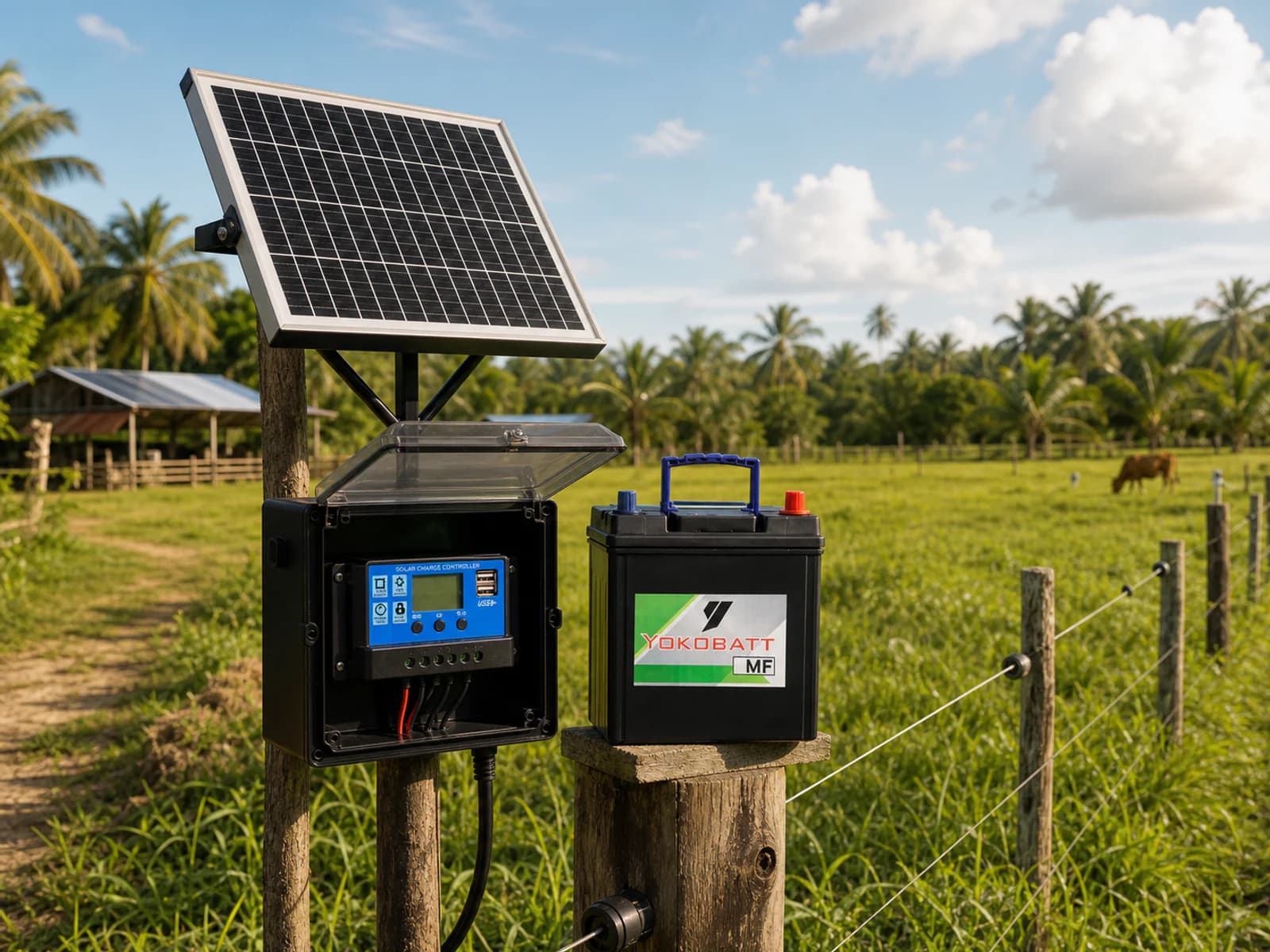
Solar panels, deep-cycle batteries, and charge controllers for running electric fence energizers — and other off-grid equipment — on remote farmland with no mains connection.
Match the panel and controller to the battery voltage and energizer demand. Consider sunlight, battery capacity, charging losses and protection from weather.
Technical guidance from Pang Electronics. Purchasing happens in PE Mall Store.
Remote paddocks, plantation boundaries, and orchard perimeters often sit well beyond a convenient mains connection. A solar power kit — panel, charge controller, and deep-cycle battery — keeps an energizer (or other 12V farm equipment) running continuously, day and night, without cabling back to the grid.
The solar panel charges a rechargeable battery through the day; the battery then powers the connected equipment continuously, including overnight and through Malaysia's periodic cloudy stretches, provided the panel and battery are sized correctly for the load. Under-sizing either component is the most common reason a "solar" energizer setup underperforms compared with its mains-powered equivalent.
Panel and battery size should be matched to the energizer's power draw (larger, higher-joule energizers need more charging capacity) and to how much reliable sun the site gets — a site with regular afternoon shade needs more panel capacity than one in full open sun. A solar controller installation guide covers wiring and setup in more detail.
Solar power kits are most common on plantation boundaries, orchard perimeters, and livestock paddocks distant from existing power infrastructure — anywhere a mains-powered energizer isn't practical to install.
A remote solar fence normally needs a solar panel, charge controller, suitable rechargeable battery and an energizer compatible with the battery voltage.
A solar panel charges a battery through a controller, and the battery powers the energizer when sunlight is unavailable.
Insufficient sunlight, an undersized panel, an old battery, incorrect controller settings or loose connections can reduce available power.
Use a suitable enclosure, correct polarity, secure terminals and a controller matched to the battery chemistry and voltage.