
Farm application
Electric Fence for Banana Farms in Malaysia
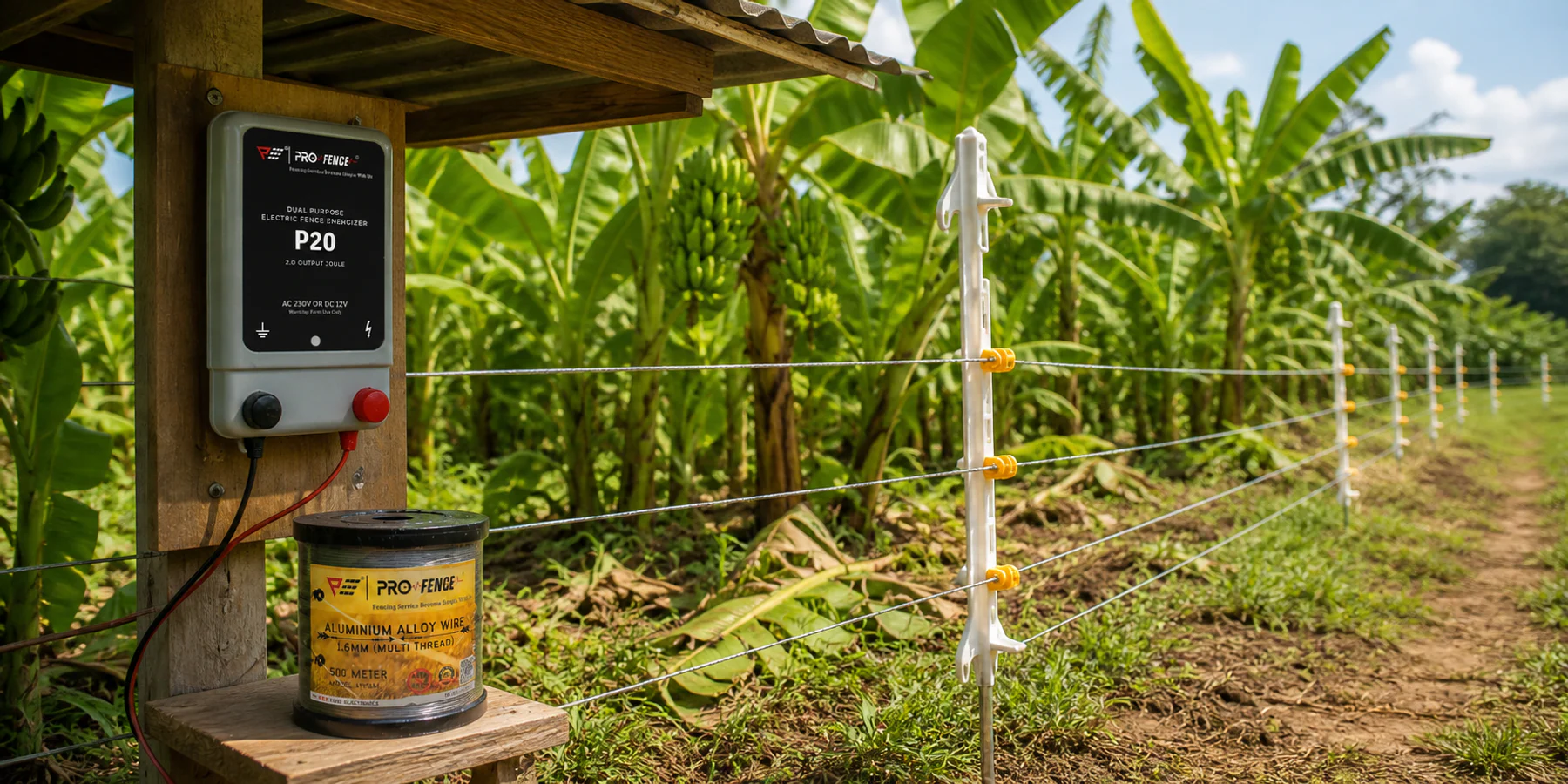
Electric Fence for Banana Farms in Malaysia
Electric fencing protects banana farms from wild boar, which damage the corm and pseudostem while foraging at ground level, and from monkeys and macaques, which strip and steal ripening bunches. Because bananas are relatively low-cost to plant and grow to harvest in around nine to twelve months rather than the years durian or oil palm need, most Malaysian banana growers are best served by a simple, affordable one- or two-strand electric fence rather than a heavily engineered perimeter — the goal is keeping fencing cost proportionate to a fast-cycling, lower-value-per-plant crop. This makes banana one of the clearest cases in Malaysian agriculture where an entry-level energizer and basic polywire fence pays for itself quickly.
Why Banana Farms Need Electric Fencing
Banana is grown across Malaysia at everything from backyard clusters to organised smallholder plots of an acre or two, often in Johor, Perak, Pahang and parts of Sabah, frequently as a mixed planting alongside other fruit or intercropped with young oil palm or durian while those slower crops mature. Because a banana plant fruits from a single large bunch and then is typically cut down and replaced by a sucker from the same corm, damage to that one bunch or to the corm itself represents the loss of the plant's entire productive cycle, not just a partial loss.
Unlike durian, where the fencing decision is about protecting a long-term, high-value tree, banana fencing decisions are about protecting a faster-turnover crop economically — the fence needs to cost noticeably less than the value of the crop it protects, or it doesn't make sense for a smallholder plot. This is exactly the scenario where simpler, lower-cost fencing does the job well, without needing the strand count or energizer output that a durian orchard or oil palm boundary requires.
The Main Threats to Banana Farms
Wild boar damage banana plants at ground level by rooting around the base of the plant in search of the starchy corm, which they eat directly, and by knocking down the pseudostem (the banana plant's soft, layered "trunk") while foraging nearby. Because the corm is the part of the plant that produces the next generation of suckers, boar damage at the base can end a plant's productive cycle outright rather than just costing one harvest. Boar tend to target banana plots adjacent to secondary forest, scrub or oil palm interplanting where they already move through looking for other food.
Monkeys and macaques are usually the more visible threat on banana farms, since they raid ripening bunches directly, often stripping and discarding far more fruit than they actually eat as they move through a plot. Because banana bunches ripen visibly on the plant and are easy for a monkey troop to access without needing to climb far, banana plots near forest edge or unmanaged scrub are particularly exposed. Losses from monkey raiding are a widely reported issue on Malaysian smallholdings generally, and banana, with its low-hanging, easily grabbed bunches, is one of the more exposed crops.
Rats and porcupines can also gnaw at the base of young banana plants in some areas, though this is a secondary concern compared with boar and monkey pressure and is usually managed separately from fence planning.
Recommended Fence Design for Banana Farms
Given the scale most Malaysian banana growers operate at, a single or double-strand polywire fence around the plot perimeter is usually sufficient to deter wild boar, which is the threat ground-level fencing addresses most directly. A bottom strand at around 20–25cm handles rooting boar effectively; a second strand around 45–50cm adds a meaningful extra deterrent for very little additional cost, which is often worthwhile given how cheap an additional strand of polywire is relative to the value of a protected banana plot.
Fencing has real limits against monkeys, exactly as it does on other Malaysian orchard crops — a troop moving through canopy or entering from an unfenced neighbouring plot won't be stopped by a ground-level wire. For plots with confirmed monkey pressure, the fence should be treated as the boar-deterrent layer, with monkey management handled through complementary measures such as keeping boundary vegetation trimmed back so troops have less cover to approach from, and harvesting bunches promptly once they reach maturity rather than leaving them to ripen fully on the plant.
Because banana plots are often smaller and more irregularly shaped than orchard or plantation land — squeezed into odd-shaped smallholdings, riverbank strips or gaps between other crops — the fence design should prioritise simplicity and ease of repositioning over permanence. Polywire on lightweight step-in posts is easy for a smallholder to move as planting rotates or as suckers are thinned and replanted in a new section of the plot.
How Banana Fencing Compares to Other Malaysian Crop Fencing
Banana sits at the lower-cost, lower-complexity end of Pemall's crop fencing guides, which is worth seeing at a glance before deciding how much to invest:
| Factor | Banana | Durian | Oil palm (plantation scale) | |---|---|---|---| | Primary threat | Wild boar (corm/pseudostem), monkeys (fruit) | Wild boar, civets, monkeys, occasional elephants | Wild boar, elephants (forest-boundary blocks) | | Typical strand count | 1–2 | 3–5 | 3–5, more on elephant sections | | Typical wire type | Polywire | Polywire and/or high-tensile | High-tensile (permanent boundary) | | Typical energizer tier | Entry-level | Mid-range to higher | Higher output, often multiple units | | Crop value per plant/tree | Lower, fast-cycling | High, especially Musang King | Lower per palm, very high in aggregate |
This is a general planning comparison, not a specification for any particular property — actual requirements depend on real perimeter length, terrain and confirmed local wildlife pressure.
Energizer Sizing for Banana Farms
Banana plot fencing typically involves much less total wire length than a durian orchard or oil palm boundary, since plots tend to be smaller and strand counts lower. This means most smallholder banana growers are well served by entry-level energizers at the lower end of the output range, which keeps the overall cost of protection proportionate to the value of the crop being protected. Growers combining a banana plot with a larger adjacent planting (durian, oil palm, or a mixed smallholding) should size the energizer for the combined fence length across the whole property rather than treating the banana section in isolation — see /tools/energizer for a sizing estimate based on actual wire length.
Wire Recommendations
Polywire is the standard and most cost-effective choice for banana farm fencing, and it suits the scale and layout of most Malaysian banana plots well: it's inexpensive, easy to install without specialist tools, simple to reposition as planting rotates, and clearly visible to anyone working the plot. High-tensile steel wire is generally unnecessary for banana fencing unless the fence forms part of a larger, permanent boundary shared with another crop on the same land, in which case the wire specification should follow whichever crop has the more demanding requirement.
Installation Tips Specific to Banana Farms
Keep the fence line clear of the banana plants' own broad leaves, which grow quickly and will droop onto a low strand within weeks if the fence runs too close to the planting row — leaving a metre or so of clearance between the fence and the nearest plant avoids this becoming a recurring maintenance chore. Because banana plots are often replanted or expanded as suckers mature, plan the fence with some slack in mind for repositioning every season or two rather than treating it as a fixed, permanent structure. Position the energizer somewhere it won't be shaded out by the banana canopy if running solar, and check the earthing periodically, since Malaysia's humid growing conditions affect earth performance the same way they do on any other crop. If the banana plot borders an oil palm or durian planting with its own fence, consider whether the two can share a single connected perimeter and one larger energizer rather than running two separate systems, which is usually more cost-effective for mixed smallholdings.
Frequently asked questions
Is electric fencing worth it for a small banana plot?
Yes, for most plots facing wild boar pressure, because the fence cost is low relative to the value of a protected crop cycle, and a single incident of boar damage to the corm can end a plant's productive cycle entirely.
How many strands of wire does a banana farm fence need?
A single strand at around 20-25cm is often enough for boar deterrence on a small plot; a second strand around 45-50cm adds extra protection at low additional cost and is common practice.
Will an electric fence stop monkeys from stealing banana bunches?
Not reliably on its own, since monkeys move through canopy and can enter from unfenced neighbouring land. The fence primarily addresses boar; monkey pressure is better managed by trimming boundary vegetation and harvesting bunches promptly.
What size energizer suits a banana smallholding?
Most banana plots have modest total wire length, so an entry-level energizer is usually sufficient. Growers with a mixed plot alongside durian or oil palm should size for the combined fence length instead.
What wire type is best for banana farm fencing?
Polywire is the standard choice — affordable, easy to install and reposition, and well suited to the smaller, often irregular plots typical of Malaysian banana smallholdings.
How close should the fence be to the banana plants?
Leave roughly a metre of clearance from the nearest plant, since banana leaves grow quickly and will droop onto a low strand if the fence sits too close.
Can I move the fence as I replant or expand the plot?
Yes, and this is one of the reasons polywire on step-in posts is preferred for banana farms — it's designed to be repositioned as suckers are thinned and new sections are planted.
Do I need high-tensile steel wire for a banana farm?
Generally not, unless the fence forms part of a larger permanent boundary shared with another crop that has more demanding requirements.
What causes the most damage to banana plants from wild boar?
Boar root around the base of the plant for the starchy corm and can knock down the pseudostem while foraging, and damage to the corm specifically can end that plant's productive cycle since it's what produces the next generation of suckers.
Are rats or porcupines a concern for banana farms?
They can gnaw at the base of young plants in some areas, but this is a secondary issue compared with wild boar and monkey pressure and is usually managed separately from fence planning.
Can a banana plot share a fence with an adjoining durian or oil palm planting?
Yes, and for mixed smallholdings this is often more cost-effective than running two separate fence systems, provided the wire specification and energizer are sized for the combined perimeter.
Does the fence need to run on solar power?
Only if the plot lacks mains access. Many smallholder banana plots are close enough to a farmhouse or existing power supply that mains-powered energizers are practical, though solar remains an option for remote plots.
How often should a banana farm fence be checked?
At least at the start of each new planting cycle and after any major storm, since banana's fast growth means vegetation contact with the wire can build up quickly; see `/guides/electric-fence-maintenance-guide`.
What's the most budget-friendly way to fence a banana plot?
A single-strand polywire fence with an entry-level energizer covers most wild boar pressure at minimal cost, which is why StarForce energizers paired with Tiron polywire are a common combination for banana smallholdings.
Is banana fencing different from durian or oil palm fencing?
Yes — the underlying principle is the same, but banana fencing is generally simpler and cheaper because the crop's lower value per plant and faster growth cycle mean the fence only needs to be proportionate to a smaller, faster-turning investment.