
Farm application
Electric Fence for Durian Farms in Malaysia
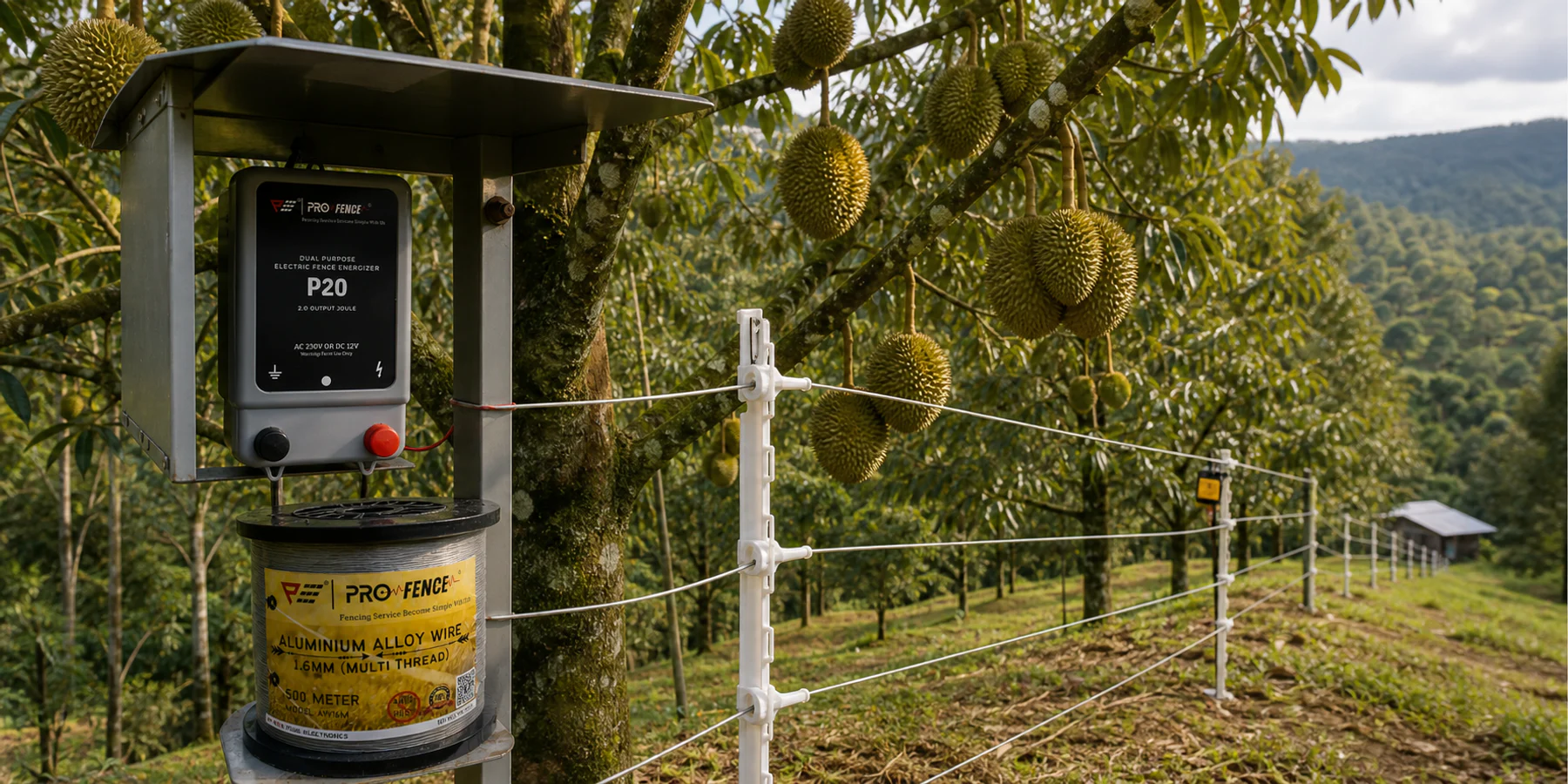
Electric Fence for Durian Farms in Malaysia
Electric fencing protects durian orchards mainly from wild boar, which root at tree bases and damage surface roots and young trunks, and from civets and monkeys that raid ripening fruit. A correctly designed perimeter fence — typically three to five live strands run around the orchard boundary and along access tracks — gives most Malaysian durian growers a cost-effective way to protect trees that can take seven or more years to reach full bearing. Because a single mature Musang King tree can represent a meaningful chunk of a season's income, the payback on a proper fence is usually measured in a single avoided incident, not years.
Why Durian Orchards Need Electric Fencing
Durian is one of the few crops in Malaysia where the economics of fencing are rarely in question. A young tree takes several years of care before it produces anything, and a mature, well-grafted Musang King, D24 or Black Thorn tree represents a long-term asset that a single night of wild boar rooting or a bad monkey season can set back significantly. Unlike annual crops where a bad season is recoverable within a year, damage to a durian tree's root system or bark can affect yield for several seasons afterwards.
Durian orchards in Malaysia are concentrated in hill and foothill districts — Raub and Bentong in Pahang, Gua Musang and Kelantan's highlands, Balik Pulau in Penang, parts of Johor and Perak — many of which sit close to secondary forest or forest reserve boundaries. That proximity to forest edge is exactly where wildlife conflict is worst, because wild boar, civets and monkeys move along the forest-farm interface looking for food. This is the same dynamic seen in oil palm and rubber smallholdings in the same districts, but for durian the stakes per tree are higher.
The Main Threats to Durian Trees
Wild boar (babi hutan) are the most consistent threat. They root and dig around tree bases searching for fallen fruit, tubers and insects, which exposes and damages surface roots — a serious problem for durian, which is shallow-rooted compared with many tree crops. Boar will also knock down young saplings simply by rubbing against them or digging nearby, and they are drawn to orchards specifically at fruiting time by the smell of ripening and fallen fruit. Boar activity tends to spike at night and during the fruiting season (roughly June–August and November–February in most of Peninsular Malaysia, with some variation by district and cultivar).
Civets (musang) are so closely associated with durian that Malaysia's best-known cultivar, Musang King, is named after them — "musang" is Malay for civet, the animal historically found feeding on fallen durian in Kelantan's wild orchards. Civets climb into trees and eat ripening fruit directly, and unlike boar they don't need the fruit to fall first, so they can cause losses even before harvest. They're harder to keep out with a ground-level fence alone, which is why many orchard owners combine perimeter fencing with individual fruit netting or bagging on high-value trees.
Monkeys and macaques raid orchards for fruit, often working in troops and causing losses well beyond what they actually eat, since they knock down and discard fruit while foraging. Culling programmes run by state wildlife authorities exist precisely because boar and monkey crop-raiding is a recognised, ongoing problem across Malaysian farmland, not an occasional nuisance.
Elephants are a real but geographically limited concern — mainly for orchards near forest reserves in parts of Pahang, Kelantan and Johor where elephant range overlaps with agricultural land. Where elephant presence is confirmed in the district, fence design needs to account for a much larger animal that can push through standard boar-height wire; this typically means higher strands, a higher-output energizer, and treating the fence as one part of a wider deterrence plan rather than a standalone solution — see the oil palm guide's discussion of elephant-scale fencing for the detail.
Theft of fruit is also a genuine and separate problem in high-value orchards, especially for Musang King. Growers in several states have reported people entering orchards before dawn to collect freshly fallen fruit. This isn't a wildlife issue, but it does factor into fence design — an energized perimeter with a warning buzzer or alarm output does double duty as a deterrent to trespassers, not just animals.
Recommended Fence Design for Durian Orchards
Most Malaysian durian orchards do best with a multi-strand perimeter fence, three to five live wires run around the full boundary of the planted area, following the natural contour of the land rather than cutting straight lines through slopes. Durian is very often grown on hilly or terraced ground, and a fence that follows the contour keeps wire tension even and avoids the sagging or over-tightening that happens when a straight line crosses uneven terrain.
Strand heights for a boar-and-monkey-focused fence typically run from around 20–25cm off the ground for the lowest wire (boar height) up to roughly 90–100cm for the top wire, with two or three wires spaced between. Orchards with confirmed monkey pressure sometimes add a higher strand or angle the top wire outward, since monkeys can jump or approach from tree branches outside the fence line rather than climbing the fence itself — no ground-level fence fully solves a monkey problem where trees overhang the boundary, so canopy management (keeping boundary trees trimmed back) matters alongside the fence.
Because civets are climbers, a ground-level perimeter fence will slow but not fully stop them. For orchards where civet fruit loss is a known problem, many growers combine the perimeter fence (which handles boar, the highest-damage threat) with individual fruit netting or bagging on the highest-value trees near harvest, rather than trying to build a fence tall and complex enough to exclude a climbing animal on every tree.
On sloped terrain, plan extra grounding at low points where soil tends to stay wetter, and check post spacing more carefully than you would on flat ground — posts on a slope take more sideways load and benefit from being spaced slightly closer together, particularly on outer bends. Gates and access points for lorries and pickers need their own energized cut-off or gate handle so the fence can be opened for harvest without powering down the whole perimeter.
Energizer Sizing for Durian Orchards
Energizer output needs to match total fence wire length, not just orchard area — a fence with five strands around a one-hectare orchard has roughly five times the wire length of a single-strand fence around the same area, and every metre of wire draws down the energizer's output, especially where vegetation contacts the lower strands. As a general planning guide, smallholder orchards under a few hectares with modest wire length are often adequately served by energizers in the low single-digit joule range, while larger orchards, longer perimeters, or fences carrying more strands need proportionally more output. This is general guidance for planning purposes, not a specification for a particular product — use the joules calculator below or speak to Pemall's team with your actual perimeter length and strand count for an accurate recommendation.
For orchards in areas with confirmed elephant presence, energizer sizing changes substantially, since deterring an elephant requires a fence that delivers enough of a jolt through thick hide to register — see /guides/how-many-joules-do-i-need for the general framework, and treat any orchard near elephant range as a higher-output case regardless of its physical size.
Wire and Strand Recommendations
Polywire or poly tape is common for durian orchard perimeters because it's easy to install and reposition around trees and access tracks, and it's clearly visible to workers and pickers moving through the orchard — an important safety consideration on a working farm with regular foot traffic. High-tensile steel wire is a longer-lasting option for permanent boundary sections that won't be moved, particularly on the outer perimeter facing forest edge, where the fence is a fixed, long-term structure rather than something adjusted season to season. Many orchards use a mix: high-tensile wire on the permanent forest-facing boundary and polywire on inner sections that flex around planting rows or get repositioned as the orchard matures.
Installation Tips Specific to Durian Farms
Walk the planned fence line before installing anything — durian orchards are rarely flat, and identifying dips, wet patches and existing tree rows in advance saves re-work. Keep the fence line clear of overhanging durian branches and undergrowth, since vegetation touching a live wire is one of the most common causes of a weak or "leaking" fence, and it's a bigger issue in orchard settings than open pasture because of how densely the canopy grows once trees mature. Position the energizer somewhere dry, shaded and reasonably central to the fence run to minimise voltage drop to the farthest point, and earth (ground) it properly — in Malaysia's high-rainfall, high-humidity climate, poor earthing is one of the most common reasons a fence underperforms. Brief pickers, contractors and family members on gate locations and how to switch the fence off safely before entering for harvest.
Frequently asked questions
Does an electric fence actually stop wild boar from durian orchards?
Yes, when strands are set low enough (around 20–25cm for the bottom wire) and the fence delivers a strong enough pulse, wild boar quickly learn to avoid the fence line after an initial contact. It is one of the most effective non-lethal deterrents available for orchard boar control in Malaysia.
Will an electric fence keep civets out of my durian trees?
A ground-level fence alone will slow but not fully exclude civets, since they climb. Most orchards pair perimeter fencing (which handles boar, the biggest source of damage) with fruit netting or bagging on individual high-value trees near harvest to address civet losses.
How many strands of wire does a durian orchard fence need?
Three to five strands is typical, with the lowest wire around 20–25cm off the ground for boar and additional strands up to roughly 90–100cm for general deterrence. Orchards with monkey pressure sometimes add a higher strand.
What size energizer do I need for a durian orchard?
It depends on total wire length (perimeter multiplied by number of strands), not just land area. Small orchards under a few hectares typically need less output than larger, multi-strand perimeters; use `/tools/energizer` with your actual figures for an accurate estimate.
Can electric fencing be installed on hilly or terraced durian land?
Yes, and most Malaysian durian orchards are on sloped ground. The fence should follow land contour rather than run in a straight line, with attention to grounding at low points and slightly closer post spacing on slopes and bends.
Do I need a different fence if there are elephants near my orchard?
Yes. Elephant-range orchards need a higher-output energizer and a fence treated as part of a broader deterrence approach, not a standalone barrier. See `/guides/electric-fence-for-oil-palm` for more detail on elephant-scale fencing considerations, which apply similarly to orchards near the same forest boundaries.
Will an electric fence stop people from stealing durian fruit?
An energized perimeter with a warning buzzer or alarm output is a meaningful deterrent to trespassers, though it is primarily designed for wildlife exclusion. Growers concerned specifically about fruit theft often look at StarLite's alarm and monitoring features as an added layer.
How close to the trees should the fence be built?
The fence generally runs around the orchard's outer boundary rather than around individual trees, positioned far enough from the tree line that falling fruit and low branches don't interfere with the wire.
Does rain affect how well the fence works?
Wet vegetation touching the wire reduces effectiveness, and poor earthing performs worse in Malaysia's humid climate. A well-earthed system with cleared fence lines works reliably through the wet season, but regular checks after heavy rain are good practice.
Can I run an electric fence off-grid on a remote orchard?
Yes, solar or battery-powered energizers are commonly used where mains power isn't available at the orchard, which is often the case on hillside plantings some distance from the farmhouse.
How do I stop monkeys from getting into the orchard from overhanging trees?
No fence design fully solves this on its own, since monkeys can enter via canopy rather than crossing the fence line at ground level. Trimming boundary trees back from the fence line reduces this route significantly.
What wire type is best for a durian orchard, polywire or high-tensile steel?
Polywire suits inner sections and areas adjusted as the orchard matures; high-tensile steel suits the permanent outer perimeter, particularly the forest-facing boundary. Many orchards use both. See `/guides/fence-wire-buying-guide` for a fuller comparison.
Do I need a gate in the fence for harvest access?
Yes — working orchards need at least one gate or handle point for pickers and lorries, ideally with its own switch so the whole perimeter doesn't need to be de-energized for routine access.
How often does a durian orchard fence need maintenance?
Check the fence line after major storms and at the start of each fruiting season at minimum, clearing vegetation and testing voltage at the far end of the run. See `/guides/electric-fence-maintenance-guide` for a full maintenance schedule.
Is electric fencing worth it for a small backyard durian planting?
For a handful of trees, a simpler single- or double-strand fence with a smaller energizer is usually enough, and even a modest fence is often worthwhile given how much a mature tree represents. StarForce's entry-level energizers are a common starting point for smaller plantings.