
Farm application
Electric Fence for Goat Farms in Malaysia
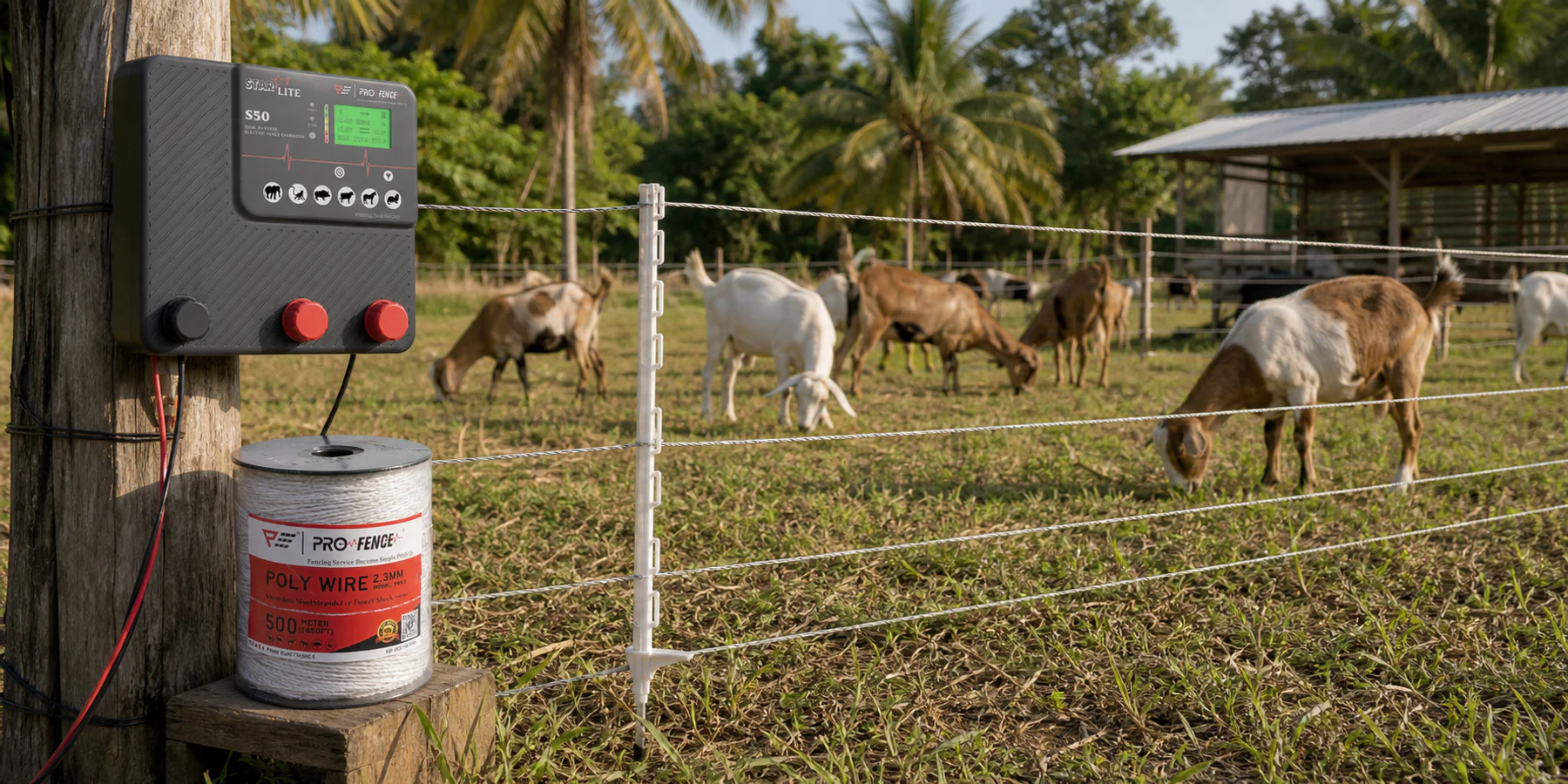
Electric Fence for Goat Farms in Malaysia
Electric fencing on a goat farm solves the opposite problem from most agricultural fencing: it exists mainly to keep goats in, not to keep wildlife out. Goats are notoriously determined escape artists that will push, rub against, or squeeze through any weak point in a fence, so a goat-containment fence needs multiple low, closely spaced strands and consistently adequate voltage rather than the wider-spaced perimeter design used for crop or orchard exclusion fencing. Keeping stray dogs and other predators away from the herd is a genuine secondary benefit of the same fence, but containment — not exclusion — is the design brief.
Containment First: Why Goat Fencing Is a Different Problem
Every other guide in this series — durian, oil palm, banana, fish ponds — is about excluding an outside threat from a fixed asset that doesn't move. A goat farm flips that logic. The goats themselves are the thing the fence has to control, and they are actively, persistently testing the fence from the inside every day, not occasionally wandering in from the forest edge like a wild boar might. This changes almost every design decision: strand spacing, strand height, voltage consistency, and how the fence is introduced to new animals all need to be planned around containing a smart, physically capable animal that learns fence weaknesses quickly if given the chance.
Goat farming in Malaysia happens mostly at smallholder scale, commonly a few dozen to a few hundred head, and is frequently integrated with oil palm smallholdings — goats grazing under and between palm rows as a secondary income stream alongside the main crop, an arrangement actively supported through government and industry integration programmes in states like Johor. The two most common breed types are the local Katjang goat, valued for its hardiness and adaptability to Malaysian conditions though modest in growth rate, and the imported Boer goat and Boer-Katjang crosses, bred for better growth and meat yield. None of this changes the fundamental fencing principles, but it does mean most Malaysian goat operations are working at a scale where a well-planned electric fence is genuinely practical rather than needing plantation-scale infrastructure.
Why Goats Are Hard to Contain
Goats are physically capable of squeezing through surprisingly small gaps, since their body shape and flexibility let them fit through openings that would stop a similarly sized sheep or calf. They're also natural climbers and jumpers, comfortable putting their front feet up on a low fence to reach over it, and herd-curious, meaning that once one goat finds a weakness, others in the herd will often follow through the same spot. A fence that's merely "mostly" energized, with one weak strand or an inconsistent earth, gets found and exploited quickly, especially by younger, more agile animals in the herd.
This is why fence design for goats prioritises over the wider, sparser spacing used on wildlife-exclusion fences. A fence built to boar-deterrent spacing, with strands only at 25cm and 90cm, leaves a large gap in between that a goat can put its head and shoulders through, whereas a goat-appropriate fence keeps that gap much tighter throughout the lower portion of the fence height.
Frequently asked questions
Why is goat fencing different from wildlife-exclusion fencing?
Goat fencing exists to keep animals inside the fence, whereas most agricultural electric fencing (for durian, oil palm, banana) exists to keep wildlife outside. This flips the design brief towards tighter, more closely spaced strands rather than a wider-spaced perimeter barrier.
How many strands does a goat fence need?
Four to five strands is typical, with the bottom three closely spaced, roughly 15-20cm apart, from about 20cm up to 60cm off the ground, and the remaining strands spaced up to around 90-100cm for taller animals.
Why do goats need closer strand spacing than other livestock?
Goats are flexible enough to squeeze through gaps that would stop similarly sized animals, and they're natural climbers and jumpers, so wide gaps between strands, adequate for other purposes, leave real escape routes for goats.
What voltage does a goat containment fence need?
Goat fences generally need to run at the higher end of the practical voltage range for livestock fencing, since a goat's coat provides some natural insulation against a weak shock. Where predator deterrence is also a factor, voltage needs are higher again.
How do you train goats to respect an electric fence?
Let new animals encounter the fence under supervision in a controlled area first, sometimes with a visible temporary barrier alongside the electric strands for the first few days, so they get one memorable shock and learn to keep their distance by sight afterwards.
Does electric fencing keep stray dogs away from goats?
Yes, a properly built and energized containment fence is a genuine secondary deterrent against stray dogs, since the same low, tight strands and adequate voltage that contain goats also make it difficult for a dog to force its way in.
What size energizer does a goat farm need?
It depends on total wire length across all paddocks and cross-fencing combined, not just the outer boundary, since a multi-strand goat fence has considerably more wire length than a single-strand perimeter of the same area.
Can I use the same fence design as a wild boar exclusion fence for goats?
No. A boar-deterrent fence typically has wide gaps between strands that a goat can put its head and shoulders through. Goat containment needs tighter spacing throughout the lower half of the fence.
Are Boer or Katjang goats harder to contain?
Both breeds and their crosses respond to the same containment principles; breed doesn't significantly change fence design, though younger and more active animals of any breed tend to test fences more.
Is polywire strong enough for goat fencing?
Yes for cross-fencing and rotational paddock divisions that get moved regularly, which suits how many Malaysian smallholder goat operations manage grazing. Permanent outer boundaries are better served by high-tensile steel wire.
What happens if the fence loses power temporarily?
Goats that experience an unpowered fence, even briefly, can lose their learned respect for it and test it more aggressively afterwards, so retraining supervision is worthwhile after any extended outage or maintenance period.
How is goat fencing typically integrated with oil palm smallholdings?
Goats are commonly grazed under and between oil palm rows as a secondary income stream, an arrangement supported by industry integration programmes, with rotational cross-fencing used to manage which block the herd grazes at a given time.
Do kid goats need different fence spacing than adults?
Fence spacing should be checked against the smallest animals in the herd, since kids are the most common escapees on a fence that's adequately spaced for adults but not for younger, smaller goats.
Where do goats most often find weaknesses in a fence?
Corners, gates, and any sagging or unevenly tensioned section, since these are where goats concentrate pressure and where a fence is most likely to underperform.
Can the same fence protect goats from predators and contain them at the same time?
Yes, this is one of the practical advantages of a well-built goat fence — proper containment specification (tight low strands, adequate voltage) achieves predator deterrence as a natural side effect, without needing a separate system.