
Farm application
Electric Fence for Oil Palm Plantations in Malaysia
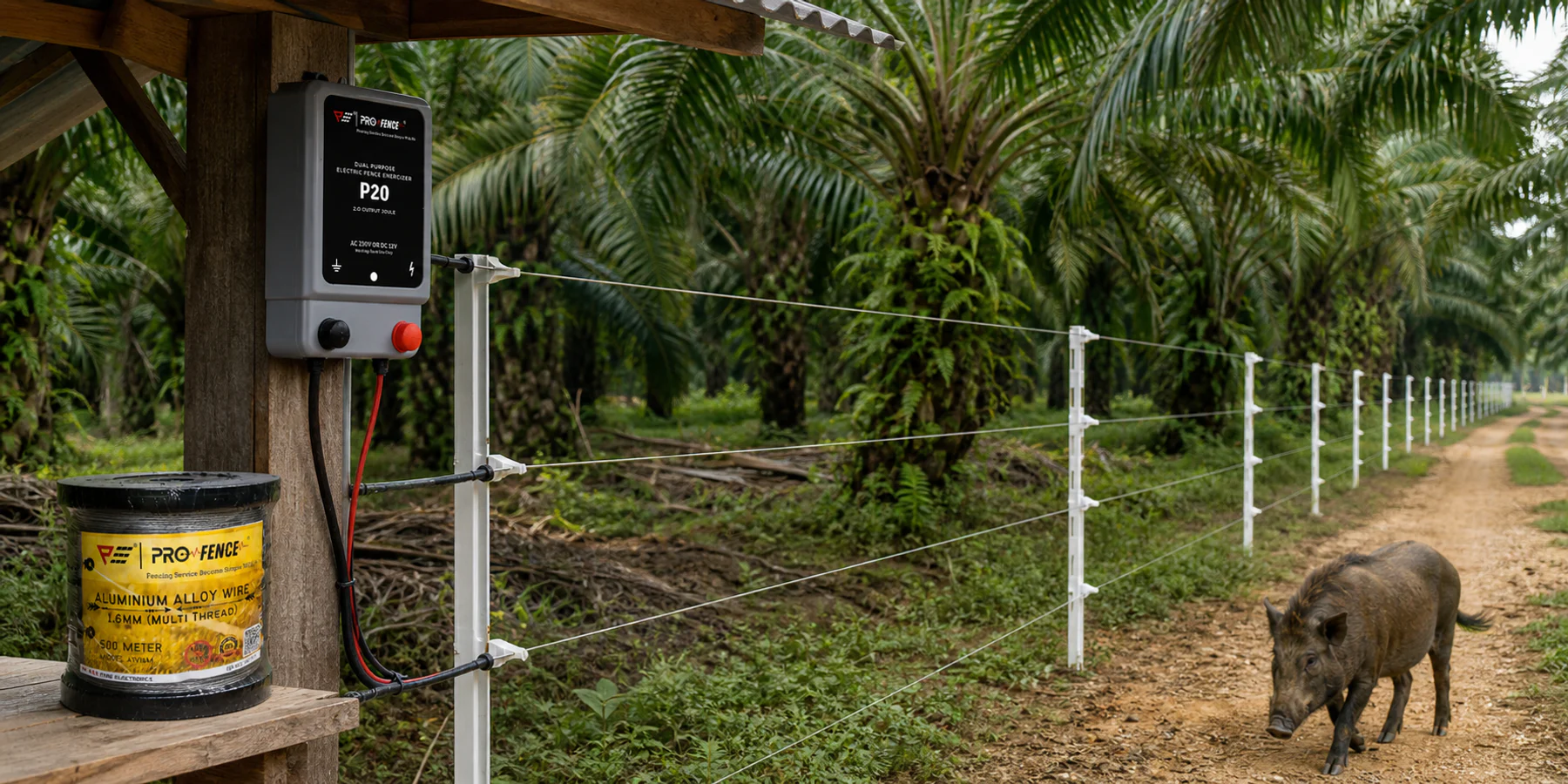
Electric Fence for Oil Palm Plantations in Malaysia
Electric fencing on Malaysian oil palm plantations is used mainly to deter wild boar, which damage young palms and nursery stock, and elephants, which push over or trample palms along the forest–plantation boundary in parts of Pahang, Johor and Sabah. Because plantations can span hundreds or thousands of hectares, fence design here is a different engineering problem from smallholder farms: it centres on long-perimeter voltage management, higher-output or multiple energizers, and solar power for boundaries far from any mains supply. Electric fencing is a genuinely useful part of a plantation's wildlife management plan, but on the largest estates and in areas with strong elephant movement corridors, it usually works best as one layer within a broader strategy rather than a fence-alone solution.
Why Oil Palm Plantations Use Electric Fencing
Oil palm is grown at a completely different scale from orchard crops like durian or banana, and that scale changes the fencing problem. A smallholding might need a few hundred metres of perimeter wire; an estate might need tens of kilometres, often running along irregular boundaries shaped by rivers, forest reserves and neighbouring land parcels. The plantation-forest edge is where almost all wildlife conflict happens, because that's where boar and elephants move out of remaining forest habitat looking for food, particularly as natural forage becomes scarcer during dry periods.
This isn't a hypothetical concern. Human-wildlife conflict in Malaysian oil palm is well documented in districts of Johor and Sabah, and large plantation groups have adopted mitigation measures — including buffer zones, drone surveillance and electric fencing — specifically because losses from elephant and boar damage along forest-adjacent blocks are a recurring operating cost, not an occasional event.
The Main Threats on Oil Palm Estates
Wild boar are the most widespread threat and the one electric fencing handles most reliably. They damage young palms in nurseries and newly planted blocks, rooting around the base of immature palms and sometimes girdling roots badly enough to kill the plant outright. Because young palm blocks represent years of growth investment before the palm reaches productive maturity, boar damage in the first two to three years after planting is disproportionately costly compared with damage to an established stand.
Elephants are a serious concern specifically in plantation blocks near forest reserves and known elephant corridors — the Kinabatangan floodplain area of Sabah, forest-adjacent blocks in Pahang, and parts of Johor near remaining forest cover are the areas most affected. Elephants can push over young and even semi-mature palms, strip fronds, and cause substantial infrastructure damage well beyond what they eat. Elephants are also large and strong enough to push through or break a fence built to boar-deterrent standards, which is why elephant-relevant sections of a plantation boundary need to be treated as a distinct, higher-specification fencing problem rather than an extension of the standard boar fence.
Frequently asked questions
Does an electric fence stop elephants from entering oil palm plantations?
It significantly reduces incursions when built to elephant-deterrent specification — higher strands, high-tensile wire and a higher-output energizer — but is not always a complete solution during periods when natural food sources are scarce, particularly in known elephant corridor areas. It works best combined with buffer zones and coordination with wildlife authorities.
How is fencing different for boar versus elephants on a plantation?
Boar-focused sections use a lower-strand, moderate-output design similar to smallholder orchard fencing. Elephant-relevant sections need a taller fence, sturdier high-tensile wire and substantially higher energizer output to register through thick hide and withstand a pushing animal.
How much of a large plantation boundary actually needs fencing?
Not necessarily all of it. Most plantations get the best return by prioritising forest-adjacent boundaries and known wildlife corridors first, since that's where the overwhelming majority of wildlife conflict occurs.
What size energizer does a plantation-scale fence need?
It depends heavily on total wire length and whether the section is elephant-relevant. Long boundaries need proportionally higher output, and elephant sections need higher output again for the same length. Use `/tools/energizer` with actual perimeter figures for a reliable estimate.
Can plantation fences run on solar power?
Yes, solar-powered energizers are the standard for remote boundary sections without mains access, which is common on large estates. Battery capacity should account for monsoon-season overcast periods.
Do macaques respond to electric fencing?
Not reliably. Macaques move through canopy and over most ground-level barriers with relative ease, so fencing has limited effect on fruit loss from macaques; this threat is generally managed separately from fence infrastructure.
Why does voltage drop matter more on plantations than smaller farms?
Long fence runs lose more voltage over distance, and vegetation contact along a multi-kilometre line compounds the effect. Plantations often need multiple energizers or sectioned fencing with isolating switches to keep voltage adequate along the entire run.
Should the whole plantation use the same fence specification?
No. Matching specification to actual risk by section — boar-standard for most of the perimeter, elephant-standard for forest-adjacent and corridor sections — is more cost-effective than a single uniform specification across the whole boundary.
What wire type suits a permanent plantation boundary?
High-tensile galvanised steel wire is standard for permanent boundaries given the distances and multi-year lifespan involved. Polywire is more suited to temporary fencing around new planting blocks or nurseries.
How often does a plantation-scale fence need maintenance?
More frequently than a small farm fence, given the length of line and the pace of tropical undergrowth regrowth. Regular vegetation clearance and voltage checks at multiple points along the line are standard practice; see `/guides/electric-fence-maintenance-guide`.
Is electric fencing enough on its own to solve human-elephant conflict?
Not on its own in areas with strong elephant movement, based on documented experience across several Malaysian plantations. It's most effective as one part of a broader approach that includes buffer zones, monitoring and coordination with state wildlife authorities.
Does fencing help protect young palm nurseries specifically?
Yes — nurseries and newly planted blocks are where boar damage is most costly relative to the plant's age, since a damaged young palm represents lost years of growth. Fencing nursery areas is often one of the higher-priority, lower-cost wins on an estate.
Can one energizer cover an entire large plantation boundary?
Usually not for very long or irregular perimeters. Most large estates use either a high-output centrally positioned energizer, multiple energizers across different sections, or sectioned fencing with isolating switches.
Do plantation fences need to be visible to workers?
Yes — plantations have regular worker and vehicle movement, so gates, crossing points and warning signage need to be clear so staff know where and how to safely cross the fence line.
What's the first step in planning a plantation-scale fence?
Map the boundary by risk — forest-adjacent and corridor sections versus low-risk edges — before specifying wire, strand count or energizer output, since this determines where budget should go first.