Maintenance
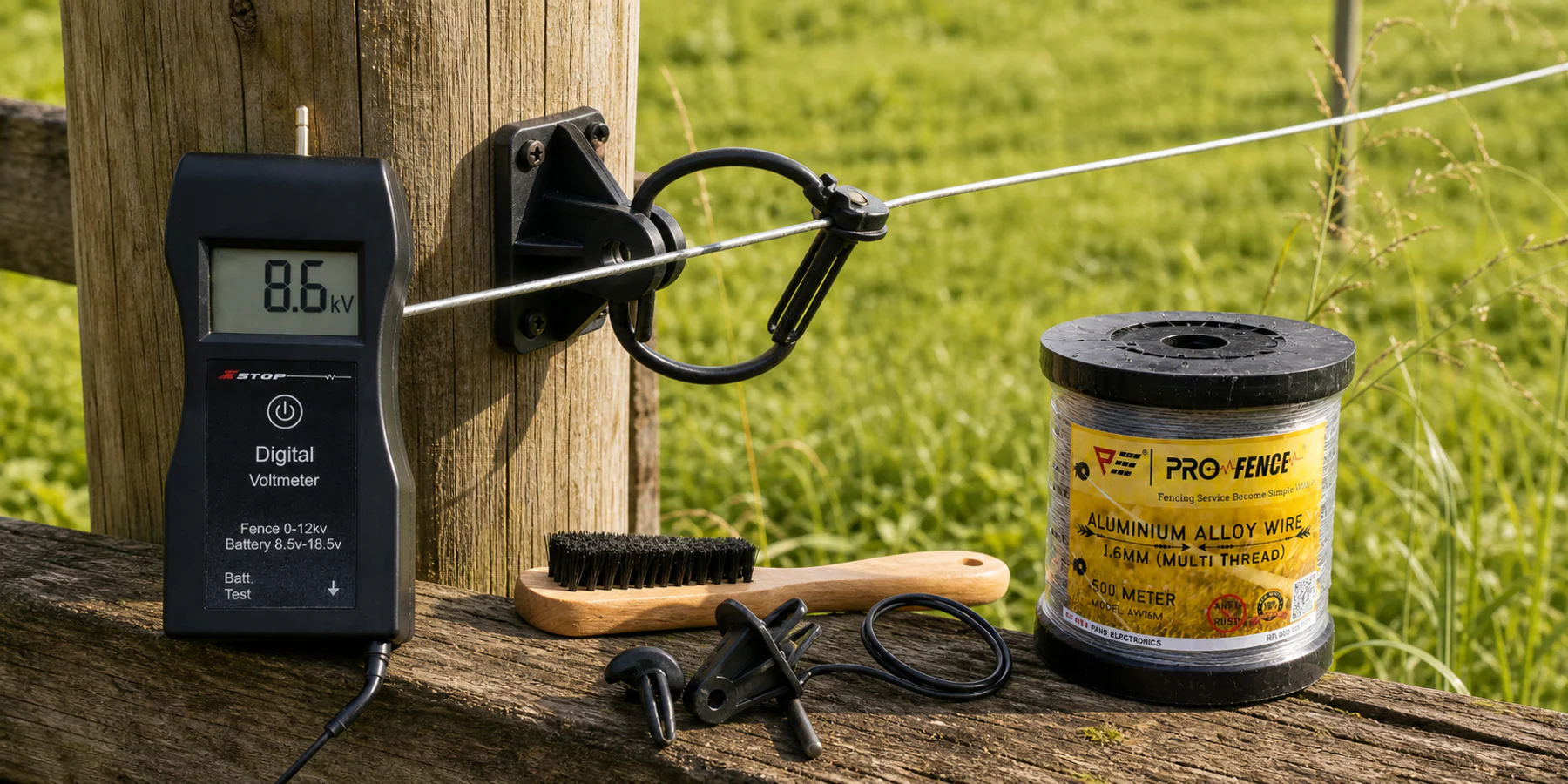
Keeping an electric fence working reliably comes down to a small set of routine checks — testing voltage along the line, clearing vegetation contact, verifying the earth system, and checking wire tension and connections — done on a regular schedule rather than only when something obviously fails. In Malaysia's climate, fast vegetation regrowth and heavy monsoon rainfall make these checks more frequent than in drier climates, particularly vegetation clearance and earth system inspection. Most common faults (weak shock, no output, or unexpected tripping) can be diagnosed with a simple voltage tester and a methodical walk of the fence line.
Voltage testing. Use a dedicated fence voltage tester (not a household electrical tester) at several points along the fence — near the energizer and at the far end — to confirm the pulse is strong enough throughout the run. A noticeable drop between the near and far end usually points to resistance along the line: vegetation contact, a poor connection, or wire that's too thin for the run length. This is worth doing weekly on active livestock or wildlife deterrent fences, and after any major weather event.
Vegetation clearance. Grass, weeds, and low branches touching the wire create a continuous partial short circuit that steadily reduces effective voltage. In Malaysia's tropical climate, vegetation beneath a fence line can regrow enough to noticeably affect performance within just a few weeks, considerably faster than the maintenance intervals assumed in temperate-climate guidance. A fence line strimmed or sprayed on a genuinely regular schedule — not just "when it looks overgrown" — is one of the single most effective things a Malaysian farm can do to keep output consistent.
Earth system checks. Inspect earth stakes and their connections for corrosion, looseness, or physical damage, and confirm the earth wire run back to the energizer is intact. In prolonged dry spells, watering around earth stakes can temporarily improve conductivity in poorly conducting soil; this is less of an issue during Malaysia's wetter months, but worth checking after an extended dry stretch.
Wire tension and breaks. Walk the fence line periodically to check for sagging wire, snapped strands, loose insulators, and posts that have leaned or been pushed over by animals or falling branches. A single break in a plain-wire fence can drop the entire circuit beyond the break point, so breaks should be treated as an immediate-fix item, not a routine backlog item.
Battery and solar panel care. For battery-powered systems, check charge level regularly and replace or recharge before the battery is fully depleted, since a weakening battery gradually reduces pulse strength before it fails outright — often mistaken for a wire or earthing fault. For solar systems, keep panels clean of dust, leaf litter, and bird droppings, and check that the panel remains unshaded as surrounding vegetation grows, which is a common and easily overlooked issue on plantation-edge installations.
Connections and insulators. Check that all wire joins, connectors, and insulators are secure and undamaged — a loose connector or a cracked insulator letting the wire touch a post are both common, easily fixed causes of reduced performance that are often mistaken for bigger faults.
| Task | Suggested Frequency | |---|---| | Voltage test at multiple points along the fence | Weekly, or after major weather events | | Visual walk of the full fence line (breaks, sagging, leaning posts) | Weekly to fortnightly | | Vegetation clearance beneath and around the wire | Every 2–4 weeks in growing season; more often after heavy rain | | Earth stake and connection inspection | Monthly, and after any extended dry spell or storm | | Battery charge check (battery-powered systems) | Weekly to fortnightly | | Solar panel cleaning and shading check | Monthly | | Full connector, insulator, and joint inspection | Every 1–2 months, or when performance drops |
Wildlife deterrent fences bordering forest reserve land, and long plantation perimeters, generally warrant the more frequent end of these intervals, since vegetation pressure and animal contact tend to be higher along those boundaries.
Malaysia's climate doesn't have a true off-season for fence maintenance the way temperate countries do, but the monsoon period (typically heavier rainfall from around October to March on the east coast, and a wetter second half of the year more broadly on the west coast) brings specific considerations:
Symptoms: Strong shock near the energizer, weak or no shock at the far end.
Likely causes: Vegetation contact along the line, a wire that's undersized for the run length, corroded or loose connections, or a partial break with the wire still making some contact.
What to check: Walk the line testing voltage at several points to isolate where the drop begins; clear vegetation first, since it's the most common and easiest-to-fix cause; then inspect connections and splices in the affected section.
Symptoms: Energizer shows no pulse, or the fence tests at zero voltage everywhere.
Likely causes: Power supply issue (dead battery, tripped mains circuit, disconnected solar panel), a full break in the wire circuit, or a fault within the energizer itself.
What to check: Confirm the power source first (battery charge, mains connection, solar panel output), then check for a complete break by testing voltage progressively further from the energizer — voltage present up to a point and then absent usually pinpoints a break.
Symptoms: The fence works intermittently, cuts out, or an energizer with fault-detection features repeatedly flags an issue.
Likely causes: A short circuit caused by heavy vegetation contact, a wire touching a metal post due to a failed insulator, water ingress into the energizer housing, or an intermittent connection that makes and breaks contact (often due to wind movement on a loose wire).
What to check: Vegetation and insulator condition first, since these are the most common causes; then check the energizer housing for water ingress or damage, particularly after heavy rain.
Symptoms: The fence tests as "on" but the shock feels noticeably weaker than expected, without an obvious break or major vegetation issue.
Likely causes: The energizer may simply be undersized for the current fence length and strand count (especially after strands or length have been added over time), or the earth system may be inadequate for the soil conditions.
What to check: Compare current fence length and strand count against the energizer's rated output — see our how many joules do I need guide — and inspect the earth system for corrosion, insufficient stake length, or dry soil conditions.
| Situation | DIY-Appropriate | Consider Professional Help | |---|---|---| | Vegetation clearance, routine visual inspection | Yes | — | | Battery/solar panel cleaning and charge checks | Yes | — | | Simple wire break repair or reconnection | Yes, usually | — | | Voltage testing and basic fault isolation | Yes, with a voltage tester | — | | Persistent voltage drop with no identifiable cause after basic checks | Attempt first | Yes, if unresolved | | Suspected earthing system inadequacy or redesign | — | Yes | | Energizer suspected faulty internally | — | Yes | | Expanding an existing fence (more strands/length) | — | Recommended, to confirm energizer sizing | | Elephant deterrent or other high-output specialist systems | — | Recommended for design and installation | | Any situation involving suspected damage to the energizer's power supply wiring | — | Yes |
As a general principle, routine and simple mechanical maintenance (vegetation, visual checks, straightforward reconnections) is well within reach for most farmers, while anything involving redesigning the earthing system, diagnosing a suspected internal energizer fault, or sizing an expanded fence is worth professional input to avoid a costly trial-and-error cycle. Pemall's sales team can be reached via the Pemall contact form or WhatsApp chat for guidance on sizing and fault diagnosis.
Weekly testing at multiple points along the fence is a good routine for active livestock or wildlife deterrent fences, with additional checks after major weather events.
This is usually caused by resistance along the line — vegetation contact, undersized wire for the run length, or corroded and loose connections — and can be isolated by testing voltage at several points along the fence.
In Malaysia's tropical climate, every two to four weeks during active growing periods is a reasonable baseline, with more frequent clearance after heavy rain, since vegetation regrowth is considerably faster here than in temperate climates.
Rain itself doesn't usually damage a properly installed fence and can even improve earth conductivity in dry soil, but heavy rain drives faster vegetation growth and can contribute to corrosion, storm damage, and waterlogging around earth stakes.
Check the power source first (battery charge, mains connection, or solar panel output), then look for a complete wire break — testing voltage at increasing distances from the energizer will usually pinpoint where the circuit is broken.
The most common causes are heavy vegetation contact creating a short circuit, a wire touching a metal post due to a failed insulator, or water ingress into the energizer housing after heavy rain.
Use a dedicated fence voltage tester at several points along the line, including near the energizer and at the far end, to identify where and how much voltage is being lost.
Keep the solar panel clean of dust and debris, check that surrounding vegetation hasn't grown to shade the panel, and monitor battery charge regularly, since a degrading battery weakens pulse strength gradually before failing outright.
Storms commonly cause fallen branches or debris contacting the wire, dislodged or exposed earth stakes from erosion, and water ingress into energizer housings — a post-storm walk-through is worth adding to your routine after significant weather events.
If voltage tests low even close to the energizer, the fault is more likely energizer-side (power supply or internal fault); if voltage is fine near the energizer but drops rapidly with distance, the earth system or wire resistance is the more likely cause.
Yes, straightforward wire breaks can usually be repaired or rejoined using standard connectors as a DIY task; persistent or repeated breaks in the same area may indicate a deeper issue such as inadequate wire tension or post spacing worth reviewing.
When basic checks — vegetation, connections, voltage testing — don't resolve the issue, or when the fault involves the earthing system design, a suspected internal energizer fault, or expanding an existing fence, professional input is worth the cost to avoid a prolonged trial-and-error process.
Check battery charge level regularly and recharge or replace before it's fully depleted, since a weakening battery reduces pulse strength gradually and is often mistaken for a wire or earthing fault.
Yes — continuous high humidity accelerates corrosion in connectors, clamps, and uncoated metal components, so a corrosion check is worth including in routine inspections rather than treating it as a rare event.