Sizing
How Many Joules Do I Need for My Electric Fence?
How Many Joules Do I Need for My Electric Fence?
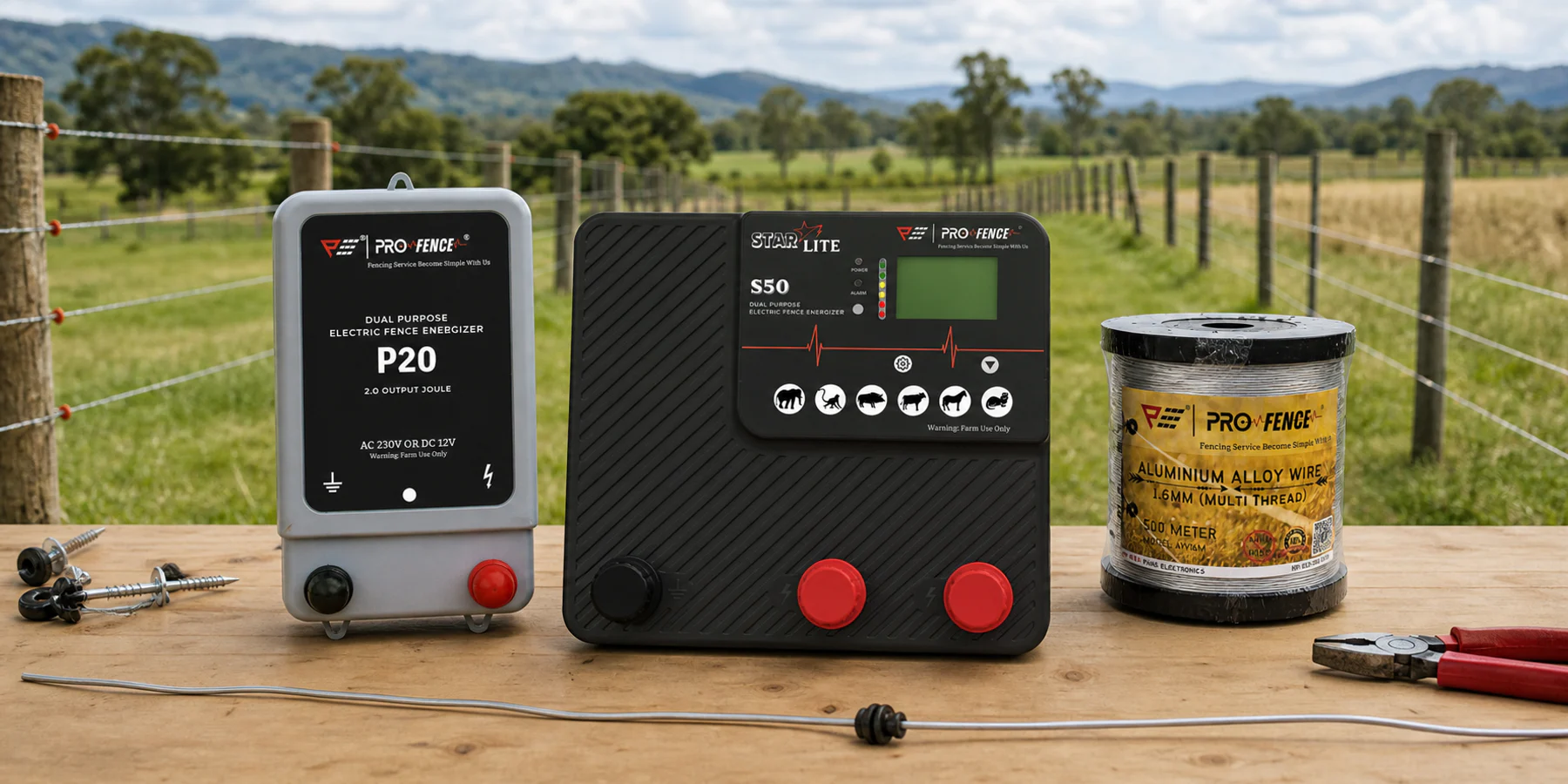
The joule output you need depends mainly on your total fence length, the number of wire strands, how much vegetation will touch the wire, and the animal you're containing or deterring — there is no single "right" number that applies to every fence. As a rough starting point, a small home or garden fence is often adequately served by well under 1 joule, a mid-size livestock farm typically needs somewhere in the low-to-mid single digits, and a large plantation perimeter or multi-strand wildlife deterrent fence often needs into the double digits of joules. These are general educational ranges for planning purposes, not a substitute for calculating your own fence's specific needs.
Joules, Explained Simply
A joule is a unit of energy, and in the context of an electric fence, it describes how much energy is delivered in each pulse sent down the wire. Think of it as the "strength" behind each shock — a higher joule rating generally means a stronger, more far-reaching pulse, capable of pushing through more resistance (vegetation, dry conditions, thick animal coats) before it weakens too much to be felt.
There are two joule figures worth understanding, because manufacturers don't always mean the same thing:
- Stored joules — the energy the energizer's internal capacitor stores before releasing it, sometimes used as a headline spec figure.
- Output joules — the energy actually released into the fence line per pulse, measured at the energizer terminal. This is the more meaningful figure for judging real-world fence performance, since some energy is lost in the release process.
Neither figure tells you what an animal actually feels at the far end of a 2-kilometre fence line — that depends on the whole system (wire conductivity, earthing, vegetation contact), not just the energizer's rated output. Joules is one input to sizing, not the whole answer. See how an electric fence works for the full explanation of joules alongside voltage and the earth-return circuit.
The Main Factors That Affect Required Output
Fence length. This is usually the biggest single factor. A longer wire run has more electrical resistance along its length, and generally more total surface area in contact with vegetation, both of which reduce the pulse strength that reaches the far end. As fence length increases, required joule output increases roughly in proportion, though not perfectly linearly, since vegetation load and wire type also play a part.
Number of wire strands. Each strand adds its own length of wire to the total circuit. A fence with four strands around a 1km perimeter effectively has 4km of wire for the energizer to drive, not 1km — this is one of the most commonly underestimated factors when farmers add strands to an existing fence without upgrading the energizer.
Vegetation load. Grass, weeds, and low branches touching the wire act as a continuous partial short circuit, constantly leaking a small amount of charge into the ground along the fence's length. In Malaysia's fast-growing tropical climate, vegetation regrowth beneath a fence line can meaningfully reduce effective output within just a few weeks of clearance if left unmanaged — this is a bigger factor here than in many temperate-climate sizing guides.
Animal type. Thicker-hided or heavily built animals such as cattle, or animals with thick protective bristle such as wild boar, generally need a stronger pulse to feel an effective, memorable shock than smaller or thinner-coated animals. Elephant deterrence sits in its own category and requires a purpose-designed, high-output system.
Terrain. Uneven terrain can mean more posts, more corners, and sometimes longer effective wire runs than the straight-line perimeter distance would suggest, all of which add to total resistance and load.
Soil and earthing quality. As covered in how an electric fence works, even a correctly sized energizer will underperform if the earth return system is inadequate for the soil type and energizer output — sizing the energizer alone isn't enough without matching earthing.
Example Sizing Scenarios
The following scenarios illustrate how the factors above combine in practice. They are illustrative planning examples, not specifications for any specific Pemall product — always confirm exact output figures against current products, or use the energizer sizing tool for a recommendation based on your actual fence.
Small home garden or vegetable plot. A short perimeter (well under 500m), single or double strand, light vegetation contact, deterring smaller animals or occasional wildlife visits. This scenario typically needs the lowest end of the output range — a compact, budget-friendly energizer is usually sufficient.
Mid-size livestock farm. A perimeter in the range of several hundred metres to a couple of kilometres, three to five strands for goats, sheep, or cattle, moderate vegetation contact requiring regular clearance. This scenario typically needs a mid-range output energizer, with the exact figure depending heavily on total strand-length once all wires are accounted for.
Wild boar deterrent fence around a smallholding or orchard. Moderate perimeter length, two to three lower strands, positioned along the treeline or forest-reserve boundary where vegetation pressure is high. This needs enough output to remain effective despite heavier-than-average vegetation contact, since boar-prone boundaries often run along less-maintained land.
Large plantation perimeter (oil palm, durian, or mixed estate boundary). A perimeter running into several kilometres, often multiple strands, significant vegetation load across a long distance, sometimes combined with elephant deterrence in states bordering forest reserves. This scenario needs the highest end of the output range, and elephant-specific deterrence should be planned as a distinct, purpose-built system rather than scaled up from a standard livestock setup.
Quick Reference Table
| Scenario | Typical Fence Length | Typical Strands | Relative Output Need | |---|---|---|---| | Home garden / small plot | Under 500m | 1–2 | Low | | Small livestock paddock | 500m–1km | 2–3 | Low–moderate | | Mid-size farm perimeter | 1–3km | 3–5 | Moderate | | Wild boar deterrent (smallholding/orchard) | 500m–2km | 2–3 | Moderate, weighted for vegetation | | Large plantation perimeter | 3km+ | 3–6+ | High | | Elephant deterrent fence | Varies, often several km | Purpose-designed | Highest, specialist system |
Why Getting This Right Matters
Undersizing an energizer is one of the most common — and most frustrating — mistakes in electric fencing. A fence that is "on" but underpowered gives farmers a false sense of security: the indicator light flashes, but the actual shock delivered at the far end may be too weak to deter a determined wild boar or a large bull, meaning the fence fails exactly when it's needed most. Oversizing, by contrast, mainly costs more upfront and in running costs (particularly for solar systems, where a bigger energizer often needs a bigger panel and battery), but rarely causes a functional problem.
Because so many variables interact — length, strands, vegetation, animal type, terrain, and earthing — the most reliable way to size an energizer accurately is to work through the actual numbers for your specific fence rather than relying on a general table alone. The energizer sizing tool takes your fence length, strand count, and animal type and gives a recommendation, and the cost estimator can then translate that into a working budget.
Signs You Need to Upgrade Your Output
If you're expanding an existing fence — adding strands, extending the perimeter, or noticing weaker performance at the far end — it's worth re-checking sizing rather than assuming the original energizer will keep up. Common signs your current output may be insufficient include: a felt shock that's noticeably weaker at the far end than near the energizer, previously deterred animals starting to push through, or repeated tripping/reduced output during vegetation growth spurts after rain. See our maintenance guide for how to diagnose whether the cause is sizing versus a fault.
Frequently asked questions
How many joules do I need for a small farm?
A small farm with a short perimeter and light vegetation typically needs a lower-output energizer, but exact sizing depends on total fence length, strand count, and animal type — the [energizer sizing tool](/tools/energizer) gives a specific recommendation.
How many joules do I need for a wild boar fence?
Wild boar deterrence typically needs a moderate output energizer, with sizing weighted toward the higher end if the boundary runs along heavy vegetation or forest-reserve land where vegetation contact is likely to be significant.
How many joules do I need to deter elephants?
Elephant deterrence needs a purpose-designed, high-output system planned specifically for the task, since elephants require considerably more pulse strength to feel an effective shock through their hide than typical livestock or smaller wildlife.
What's the difference between stored joules and output joules?
Stored joules describe the energy held in the energizer's capacitor before release, while output joules describe the energy actually delivered into the fence line per pulse — output joules is the more meaningful figure for real-world fence performance.
Does a longer fence need more joules?
Yes, generally — a longer fence has more wire, meaning more electrical resistance and more potential vegetation contact between the energizer and the far end, so it typically needs a higher-output energizer to maintain an effective shock throughout.
Do more wire strands mean I need more joules?
Yes — each additional strand adds its own length of wire to the total circuit, so a multi-strand fence needs proportionally more output than a single-strand fence covering the same perimeter distance.
Why does vegetation affect how many joules I need?
Vegetation touching the wire creates a continuous partial short circuit that leaks charge into the ground, and in Malaysia's fast-growing tropical climate this effect can be significant if vegetation isn't cleared regularly, effectively requiring more headroom in energizer output.
Can I use a smaller energizer if I clear vegetation regularly?
Diligent vegetation clearance does reduce the load on an energizer and can help a correctly-but-tightly sized system perform well, but it's still safer to size with some headroom rather than relying entirely on maintenance discipline to keep a marginal system working.
Is it better to oversize or undersize an energizer?
Oversizing is generally the safer choice — it mainly costs more upfront and in running costs, whereas undersizing can leave a fence too weak to deter animals precisely when it matters most.
How do terrain and soil type affect joule requirements?
Uneven terrain can effectively lengthen the wire run through extra corners and posts, and poor-conducting soil requires a stronger earth system to make full use of the energizer's output — both indirectly increase the practical output needed.
Does the number of joules affect running cost?
Yes — higher-output energizers generally draw more power, which is a bigger consideration for solar and battery systems, since a bigger energizer often needs a correspondingly larger panel and battery to run reliably.
Does a bigger or higher-watt solar panel give my fence more joules or a stronger shock?
No — this is a common misconception. Joule output is set by the energizer itself, not by the solar panel. A solar panel's only job is to recharge the battery that powers the energizer; a higher-watt panel charges that battery faster and more reliably, especially through cloudy or monsoon periods, but it does not increase the pulse strength or joule rating coming out of the energizer. If you need a stronger shock or longer effective range, you need a higher-output energizer — sizing the panel and battery generously just keeps that energizer running at its rated output rather than starving for power. See [solar controller installation guide](/guides/solar-controller-installation-guide) for how the panel, controller, battery, and energizer relate to each other.
How do I know if my current energizer is underpowered?
Signs include a felt shock that's noticeably weaker at the far end of the fence than near the energizer, animals starting to push through a previously effective fence, or reduced performance during vegetation growth spurts after rain.
Is there a tool to calculate joules for my specific fence?
Yes, the [energizer sizing tool](/tools/energizer) calculates a recommended output based on your fence length, strand count, and animal type.