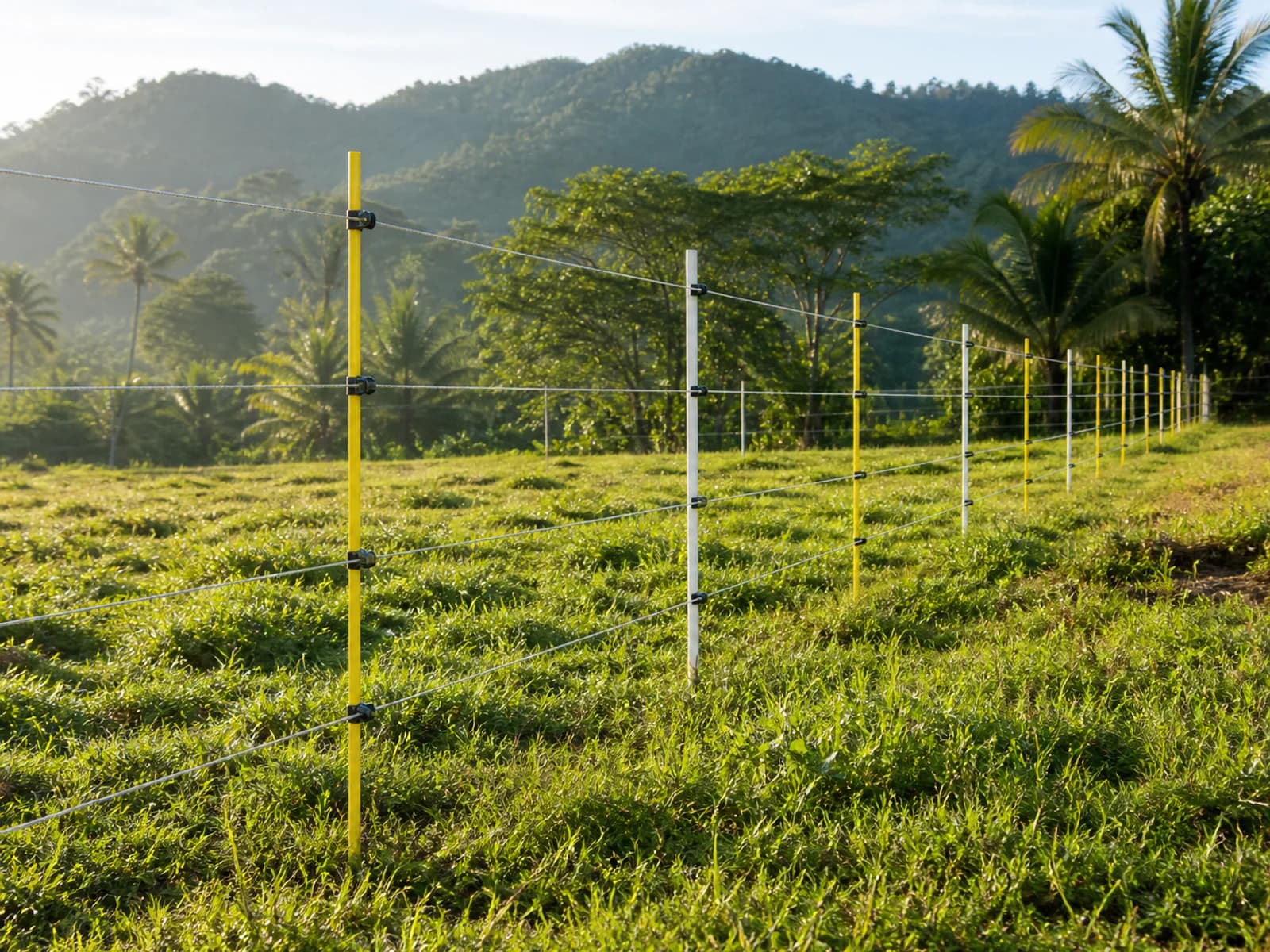
Posts hold the wire at the correct height and spacing along your boundary — timber, steel, or fibreglass, sized to your terrain and fence length.
Choose posts by height, ground condition, mobility and the number of wire strands. Confirm the post works with the selected insulators and wire.
Technical guidance from Pang Electronics. Purchasing happens in PE Mall Store.

10 mm diameter, 1.2 m fibreglass post with a pointed tip for temporary electric-fence installation.
Technical details10 mm × 1.2 m fibreglass electric-fence post supplied with one stainless-steel clip.
Technical detailsPosts are the structural backbone of an electric fence: they hold wire at the correct height and spacing, and — with the right insulators — keep it electrically isolated along the way. Line posts carry the wire between corners; corner and strainer posts take significantly more load and are usually set more firmly, often with concrete or deeper driving, since they resist the tension of the entire wire run.
Typical line-post spacing runs every few metres, tightened up on corners, uneven ground, or where extra rigidity is needed to stop the wire sagging. Malaysia's tropical conditions — wet ground, vegetation growth, and occasional flooding on lower-lying farmland — are worth factoring into post choice and depth, particularly for permanent installations expected to last several seasons.
Combine posts with matching insulators, fence wire, and an energizer sized to your perimeter. The Land & perimeter calculator helps estimate total fence length from your paddock's side measurements before you order.
Choose by required fence height, ground condition, portability and compatible insulator arrangement.
Spacing depends on terrain, wire tension, post strength and the conductor being used; follow the installation design for the site.
Many step-in or lightweight posts are designed for temporary and strip-grazing layouts, but inspect them before reuse.