
Fish · prawn · poultry farms
Monitor lizard exclusion for farms
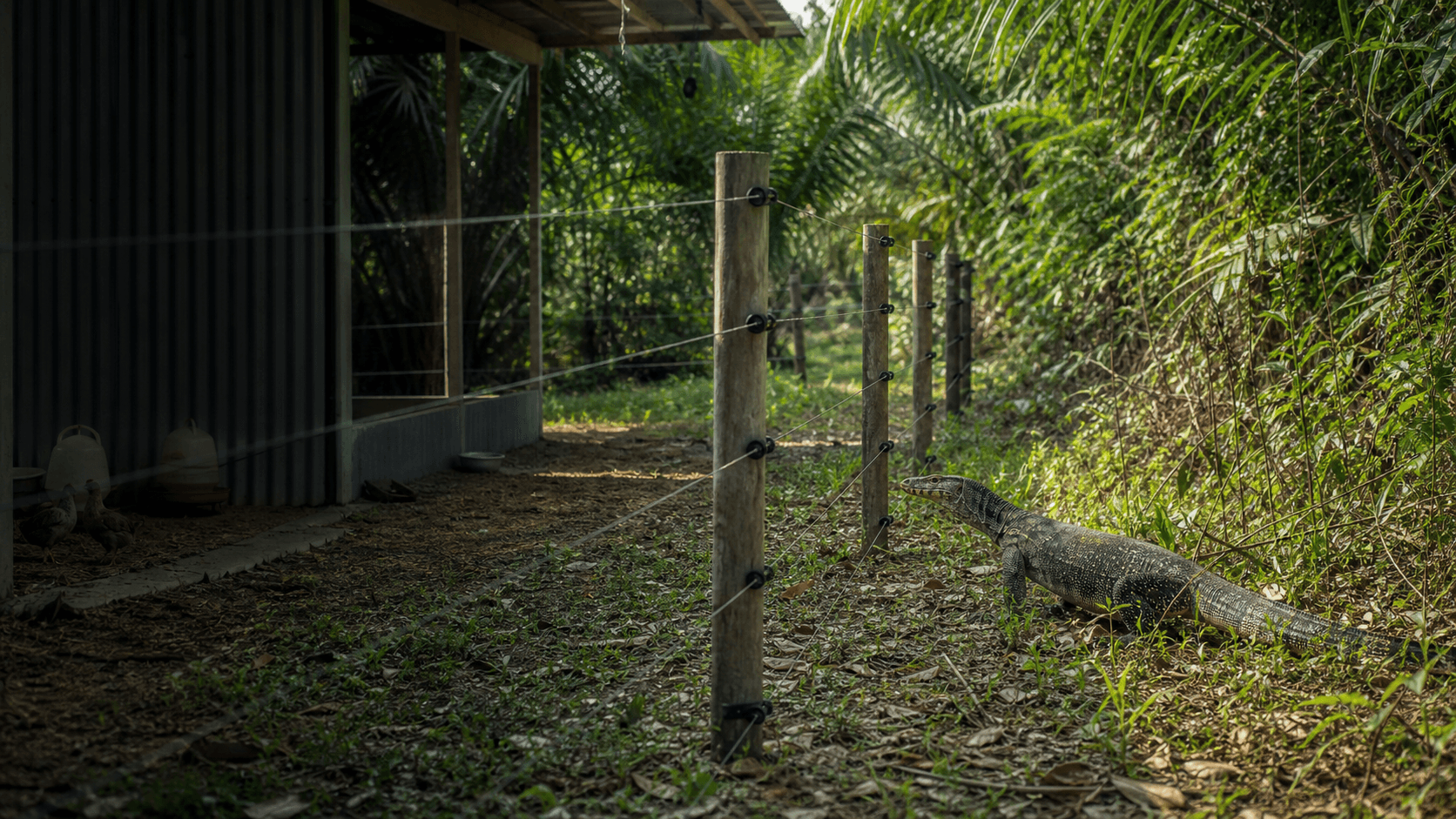
Purpose
Keep out
Electrified strands
Confirm on site
Top wire height
Confirm on site
Measured fence voltage target
Confirm on site
Energizer
Size to total fence load
Installation
Advanced · specialist review
Site assessment before wire layout
No generic wire heights or voltage are published for this application. Identify the access route and have a specialist define a suitable barrier before buying a system.
Behaviour & design
Water monitors use aquatic environments and some monitor species climb. Inspect drains, gaps, branches and feed waste. Seek wildlife help for trapped animals rather than cornering or handling them.
NParks supports physical barriers and closing gaps. We found no sufficiently strong species-specific electric design to publish exact wire heights or voltage. Any electric supplement needs a reviewed site trial; it is not an established standard.
Specialist review required before selecting an energizer or buying a kit.
Wire layout & construction
Conductor
Compare smooth fence conductors by resistance per kilometre and breaking strength. Choose visible, suitable polywire for temporary divisions; verify its resistance before long runs. Never electrify barbed wire.
Posts & corners
Set post spacing for terrain, conductor sag and the manufacturer's tension limits. Brace corners and gates; use suitable insulators and lead-out cable. More posts may be needed on uneven ground.
Choose by fence load, not acreage
Energized wire length ≈ perimeter × live strands. PEMALL's existing estimator also considers vegetation. Its Joule band is a preliminary stored-energy estimate, not a guaranteed operating voltage. Conductor resistance, grounding, animal pressure and expansion must be checked against manufacturer load data.
Calculate & find components →Power options
AC / mains
For reliable power nearby. Use an approved mains-input energizer and weather-protected installation.
12 V battery
For compatible DC energizers. Plan charging, inspections and spare capacity before the battery runs low.
Solar + battery
For remote farms. Size from actual energizer consumption, shade and cloudy-day autonomy; protect equipment from flooding and theft.
Grounding & daily checks
Follow the energizer manual for earth rods, separation and earth-return wiring. Rain does not guarantee a good earth system. Test the far end and gates with a fence tester, clear tropical growth, and inspect after storms. Correct leakage and grounding before increasing energizer size.
Build a system for my farm
Estimate wire requirements here, then continue into PEMALL's existing product and quotation flow. Specialist applications remain subject to site review.
Specialist review required before selecting an energizer or buying a kit. No generic wire heights or voltage are published for this application. Identify the access route and have a specialist define a suitable barrier before buying a system.
Ask PEMALL →Questions before you build
Why are there no wire heights here?
Precise numbers would imply evidence we do not have. Physical exclusion can be planned now; electrical details should follow a species and site review.
Can I choose an energizer just from the animal?
No. Two farms with the same animal can have very different wire loads, vegetation, grounding and power needs. Use the planner, then verify the actual fence voltage during commissioning.
Sources & scope
These sources describe particular species and sites. They support starting guidance, not a certified design for your farm. Numeric gaps are intentional where evidence is insufficient.