Choosing the right electric fence system means matching four things correctly: energizer output to your fence length and animal type, a power source to your site's access to electricity, a wire or tape type to your budget and visibility needs, and a basic set of accessories to complete a safe, working circuit. Get the energizer and earthing right first — they determine whether the whole system works at all — then choose wire and accessories to suit your budget. This guide walks through each decision in order, with a checklist at the end.
Step 1: Work Out What You're Fencing Against
Before looking at any product, define the job. The right system for keeping goats inside a paddock is different from the right system for keeping wild boar out of a durian orchard, and different again from an elephant deterrent fence along a plantation fringe.
Livestock containment (goats, cattle, sheep): moderate output, multiple strands at graduated heights, focus on durability and daily reliability.
Wild boar deterrence: lower strand height (boar are ground-level animals), robust earthing, since boar test fences with a wet snout, which conducts well.
Elephant deterrence: high-output energizer, reinforced wire runs, professional design — a standard small-farm setup will not be strong enough over distance.
Monkey deterrence: strand placement matters more than raw output, since monkeys are agile and will test fences at multiple points and heights.
General perimeter/security: moderate output, often combined with a physical boundary or existing drainage line.
Step 2: Choose Your Energizer by Fence Length, Terrain, and Animal Type
The energizer is the single most important purchase decision, because an undersized unit will never deliver an effective fence, no matter how good the wire or installation is.
Fence length. Longer perimeters need higher output, because voltage drops along the length of the wire due to resistance — a fence that works well at 200 metres may feel weak at 2 kilometres on the same energizer. As a general rule of thumb used across the industry, small home and garden fences are typically well served by energizers in the sub-1 to 2 joule range, mid-size farm and livestock paddocks typically need something in the 2–5 joule range, and larger plantation perimeters or multi-strand wildlife deterrent fences often call for 5–15 joules or more, depending on length and load. These are general educational ranges, not specifications for any particular product — see current energizer models on Pemall for exact output figures, or use the energizer sizing tool to get a recommendation based on your actual fence length and strand count.
Frequently asked questions
How do I choose the right energizer size for my fence?+
Match energizer output to your total fence length, number of wire strands, terrain, and target animal — longer, multi-strand, or heavily vegetated fences need higher output, and the [energizer sizing tool](/tools/energizer) will give a recommendation based on your specific layout.
Should I choose a mains, battery, or solar energizer?+
Choose mains power if a stable connection is available near the fence line; choose solar for remote, off-grid plantation perimeters (sized generously for Malaysia's wetter months); and choose battery power for temporary or small-scale fencing where recharging is manageable.
What's the difference between wire, tape, and polywire?+
Wire is thin, cost-effective, and best for long permanent runs; tape is wide and highly visible, suited to areas with foot traffic; polywire is lightweight and portable, suited to temporary or rotational-grazing fencing.
Do I need an earthing kit even for a small fence?+
Yes — every electric fence needs an earth system to complete the circuit, regardless of size; an undersized or missing earth system is one of the most common reasons a fence underperforms.
How much wire do I need for my fence?+
Wire quantity depends on your perimeter length and number of strands — use the [wire calculator](/tools/wire) to calculate this accurately and avoid under-ordering.
What's the difference between budget and premium energizers?+
Budget energizers deliver reliable core performance at a lower cost, while premium energizers add features like fault-warning buzzers or external alarm connectivity — the underlying safety and pulse principles are the same across tiers.
Can I start with a smaller system and expand later?+
Yes, many farmers start with a smaller energizer and standard wire, then expand output and strand count as the fenced area grows — just confirm your chosen energizer has enough headroom for planned future expansion.
What accessories are easy to forget when buying an electric fence?+
Earthing kits, insulators matched to post material, gate handles for access points, and warning signage are the most commonly under-budgeted items in a first-time purchase.
Is solar power reliable enough for Malaysia's climate?+
Yes, provided the solar panel and battery are sized generously to cope with extended cloudy or rainy periods during the monsoon season — undersized solar systems are a common cause of gradually weakening fence output.
How do I know if my energizer and wire are compatible?+
Compatibility depends on matching energizer output to wire conductivity and total fence length and load — use the [compatibility checker](/tools/compatibility) if you're unsure before finalising a purchase.
What's the best electric fence setup for wild boar?+
A robust earthing system with two to three lower strands positioned to catch a boar's snout or body at ground level, powered by an energizer sized for your total perimeter length, is the typical effective setup.
Do I need a professional installer, or can I DIY?+
Straightforward small-perimeter installations are commonly DIY-friendly, while longer runs, wildlife deterrent systems, and complex terrain benefit from professional design input, particularly on energizer sizing and earthing.
How do I estimate the total cost of an electric fence project?+
Use the [cost estimator tool](/tools/cost-estimator), which accounts for fence length, wire type, number of strands, energizer output, and accessories to build a realistic budget for your specific layout.
Which Pemall brand should a first-time buyer choose?+
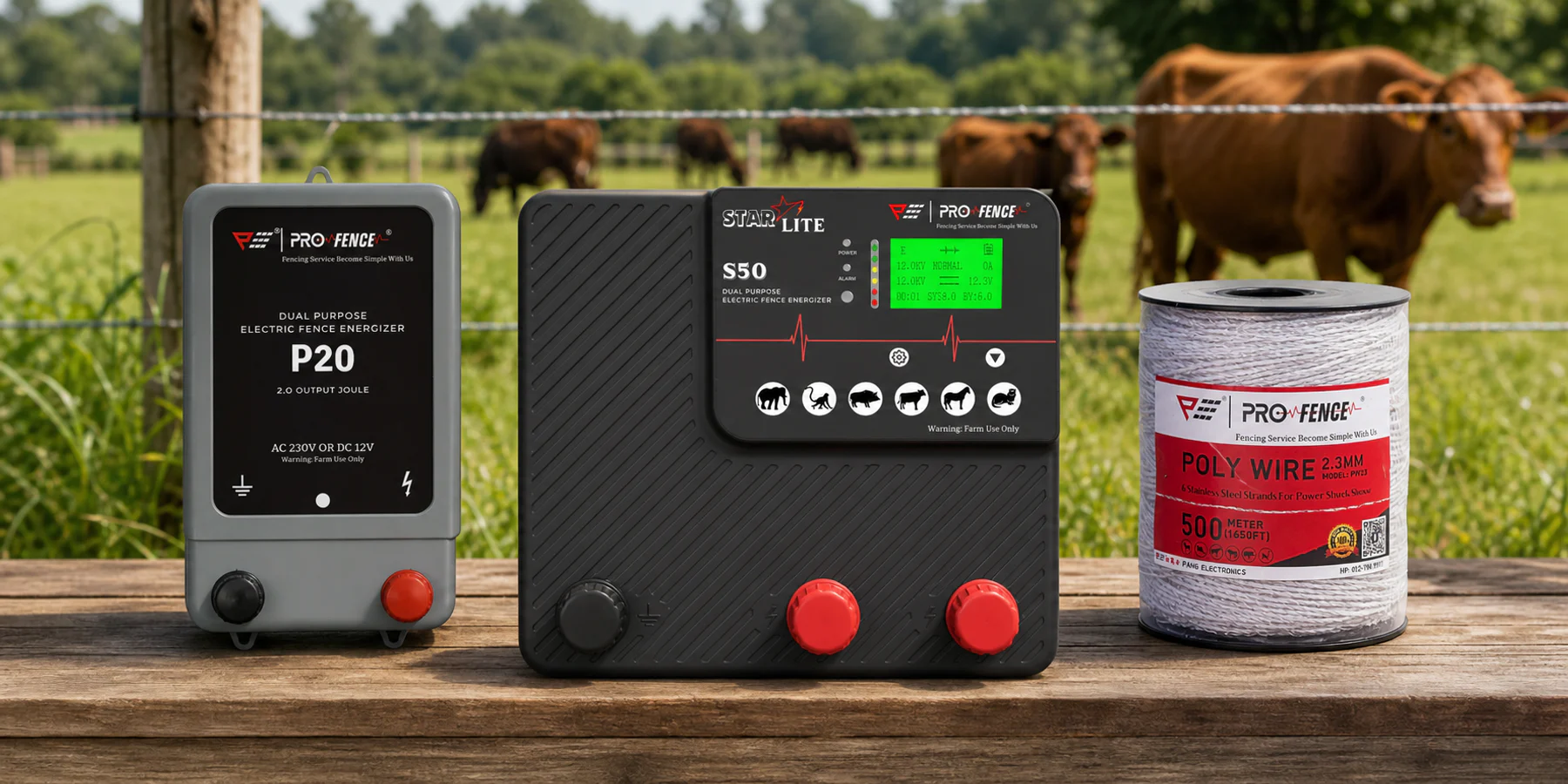
First-time buyers on a budget are usually well served by StarForce energizers paired with Tiron polywire, while those wanting a more robust, long-term farm setup often choose Pro Fence — see the [full brand decision guide](/brands/compare/which-electric-fence-brand-should-i-choose) for a scenario-based breakdown.
Terrain. Hilly, uneven, or heavily vegetated terrain increases both installation complexity and vegetation contact (which drains energizer output), so terrain that isn't flat and clear typically needs a step up in output compared with a flat, well-maintained perimeter of the same length.
Animal type. Thick-hided or heavily furred animals (cattle, boar with thick bristle) need more voltage to deliver a felt shock than short-haired or bare-skinned animals. Elephant deterrent fencing is a category of its own and needs to be planned with a higher-output, purpose-built system rather than scaled up from a small-farm energizer.
Power source. This is often decided by site access rather than preference:
| Power Source | Best For | Trade-offs |
|---|---|---|
| Mains-powered | Sites with a stable electricity connection near the fence line | Most consistent output; limited by proximity to mains supply |
| Battery-powered | Remote sites, temporary fencing, small paddocks | Needs regular recharging or battery replacement; output can drop as battery depletes |
| Solar-powered | Remote plantation perimeters, off-grid farms | No ongoing electricity cost; output depends on adequate sunlight and panel sizing; needs battery backup for cloudy/rainy stretches, relevant in Malaysia's monsoon season |
For remote Malaysian plantation boundaries far from a mains connection, solar is by far the most common choice, though it's worth sizing the solar panel and battery generously to account for extended overcast periods during the wetter months.
Step 3: Choose Wire, Tape, or Polywire
Once the energizer is sorted, choose the conductor. This is a trade-off between visibility, conductivity, mechanical strength, and cost.
Galvanised or high-tensile wire: the standard choice for permanent perimeter fencing, cost-effective and durable, but less visible than tape.
Polywire: lightweight, portable, easy to reposition — good for temporary or rotational-grazing paddock division.
Polytape: wide and highly visible, often chosen for areas with foot traffic or livestock like horses that need a strong visual cue in addition to the shock.
Poly rope: a middle ground between wire and tape — more visible than plain wire, more durable in strong wind than tape.
See the fence wire buying guide for a full breakdown of conductor types, strand counts, and Malaysian climate durability.
Step 4: Accessories You'll Need
A working fence is more than energizer and wire. The basic accessory list includes:
Posts — timber, steel, or fibreglass line posts, plus stronger corner/strainer posts.
Insulators — to isolate live wire from posts; type depends on post material (screw-in for timber, pin-lock for steel).
Earthing kit — earth stakes, earth wire, and clamps; sized to energizer output (see how an electric fence works for why this matters).
Gate handles and cut-out switches — for access points and sectioning the fence for maintenance.
Connectors and joiners — for wire splices and corners.
Warning signage — good practice anywhere the public may approach the fence.
Voltage tester — essential for ongoing maintenance, not just installation.
Step 5: Set a Budget — Entry-Level vs Premium
Electric fence systems span a wide budget range, and the right tier depends on farm size, how critical uninterrupted operation is, and whether monitoring features are worth paying for.
| Consideration | Entry-Level / Budget | Mid-Range / Professional | Premium / Smart |
|---|---|---|---|
| Best for | First-time users, small farms, testing the approach | Established farms, plantations, commercial agriculture | Farms wanting monitoring, alerts, and fault detection |
| Energizer | Reliable, no-frills output | Robust output across a wider range of fence sizes | Includes features like warning buzzers, external alarm support |
| Wire/accessories | Basic polywire and standard posts | Purpose-made fence wire and accessory ranges | Same core wire ranges, paired with smart energizer features |
| Ongoing running cost | Low | Low to moderate | Low, plus potential future connectivity features |
| Pemall brand fit | StarForce (energizers), Tiron (polywire) | Pro Fence (energizers, wire, accessories) | StarLite (premium/smart energizers) |
If you're a first-time smallholder unsure how much fence you'll ultimately need, it's reasonable to start with a reliable entry-level energizer and standard wire, and expand later — see the decision guide comparing all four Pemall exclusive brands for a fuller breakdown of which brand suits which buyer.
What to Buy: A Step-by-Step Checklist
Measure your perimeter — total fence length and number of strands needed for your animal type.
Confirm power access — is mains power available at the fence line, or do you need battery/solar?
Choose your energizer output — use the energizer sizing tool based on length, strands, and terrain.
Add gate handles, connectors, and warning signage.
Check total system compatibility — energizer output, wire type, and terrain should all match; use the compatibility checker if unsure.
Get a cost estimate — the cost estimator tool can generate a working budget based on your fence layout.
Plan for maintenance from day one — budget time (or a service arrangement) for the routine checks covered in our maintenance guide.
Malaysia-Specific Buying Considerations
Monsoon season and rainfall: choose UV- and moisture-resistant wire and tape, and size solar systems generously to cope with extended overcast periods.
Fast-growing tropical vegetation: budget for more frequent vegetation clearance than temperate-climate guidance assumes, since undergrowth beneath fence lines grows back quickly in Malaysia's climate and steadily drains energizer output if left unchecked.
Wild boar pressure: most common on plots bordering forest reserve or unmanaged land — prioritise robust earthing and lower strand placement.
Elephant corridors: relevant to plantations near forest boundaries in states like Pahang, Johor, and Kelantan — plan for a purpose-sized high-output system rather than scaling a standard farm kit.
Soil variation: sandy coastal soils and drier inland soils conduct less well than moist clay, which affects how much earthing you need — test in your specific location rather than assuming a standard earth kit will suffice.