
Buying guide
Fence Wire Buying Guide
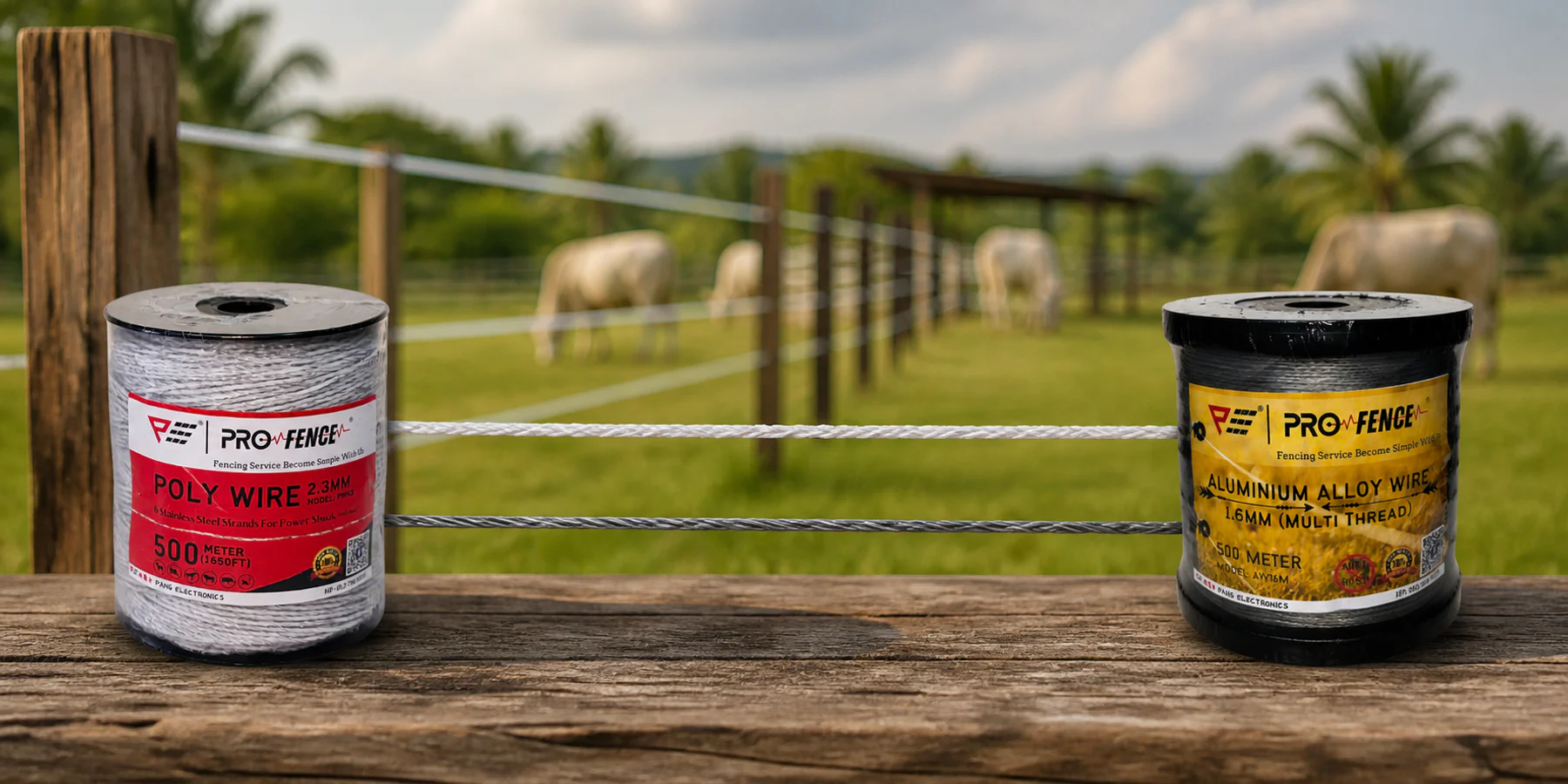
Fence Wire Buying Guide
The right electric fence wire depends on three things: how well it conducts electricity over your fence length, how well it survives Malaysia's sun and rain, and how visible it needs to be to the animals or people near it. Steel and aluminium wire conduct well and suit long permanent runs; polywire and polytape are easier to see and reposition but usually cost more per effective strand; and strand count should scale with the size and determination of the animal you're containing or excluding. This guide covers conductor types, gauge and strand count, climate durability, and energizer compatibility.
Conductor Types: What's Actually Carrying the Charge
Every fence wire, tape, or rope is built around a conductor — the metal component that actually carries the electric pulse. The surrounding material (plastic, polyethylene strands) provides strength and, in tape or rope, visibility, but does not conduct.
Galvanised steel wire. The traditional, cost-effective choice. Zinc-coated to resist rust, galvanised wire offers solid conductivity and good mechanical strength, and is widely used for permanent perimeter fencing across Malaysian farms.
High-tensile steel wire. Similar conductivity to standard galvanised wire, but manufactured to a higher tensile strength, meaning it resists stretching and sagging over long runs and can be tensioned tighter — a good choice for long-distance permanent fencing.
Aluminium wire. Offers notably better conductivity than steel for a given thickness, and is lighter to handle. This makes it a strong choice where voltage drop over distance is a concern, such as long plantation perimeters, though it is generally softer and less abrasion-resistant than steel.
Stainless steel strands (used within tape, rope, and premium polywire). Corrosion-resistant and durable in humid, high-rainfall environments, which makes stainless strand content a relevant consideration for Malaysia's tropical climate, where standard uncoated metals corrode faster than in drier climates.
Wire vs Tape vs Rope vs Polywire
These four product types solve the same job — carrying current around a perimeter — with different trade-offs.
| Type | Conductivity | Visibility | Durability | Typical Use | |---|---|---|---|---| | Plain steel/aluminium wire | Good (steel) to excellent (aluminium) | Low — thin and hard to see | High if galvanised/high-tensile; can sag if under-tensioned | Long permanent perimeters, wildlife deterrence, plantation boundaries | | Polywire | Moderate — depends on number and gauge of metal filaments woven in | Moderate | Good; flexible and easy to handle, but filaments can fatigue with repeated flexing | Temporary fencing, rotational grazing, paddock division | | Polytape | Moderate — similar filament principle to polywire, wider ribbon | High — most visible option, good for horses and foot-traffic areas | Good, but wider surface catches more wind, increasing strain on posts | Horse paddocks, areas with regular human or vehicle traffic | | Poly rope | Moderate | Moderate-high | Good — more wind-resistant than tape, more visible than plain wire | Gates, corners, general perimeter where some visibility is wanted without full tape width |
Frequently asked questions
What's the difference between electric fence wire and polywire?
Plain wire is solid metal (steel or aluminium) with high conductivity and low visibility, best for long permanent runs, while polywire is a woven polyethylene product with metal filaments inside, offering moderate conductivity, better visibility, and easier handling for temporary or portable fencing.
Is aluminium or galvanised steel wire better?
Aluminium generally conducts better for a given thickness and is lighter to handle, making it well suited to long runs where voltage drop matters, while galvanised steel offers strong mechanical durability and is typically more cost-effective.
How many strands of wire do I need for goats?
Goats typically need three to five strands with closer spacing than larger livestock, since they are agile and can slip through wider gaps if strands are too far apart.
Does electric fence wire rust in Malaysia's climate?
Uncoated or poorly galvanised wire corrodes faster in Malaysia's humidity and rainfall than in drier climates, so a good-quality zinc coating or stainless steel content is a worthwhile investment for permanent installations.
What is UV-stabilised polywire, and does it matter in Malaysia?
UV-stabilised polywire is manufactured with additives that resist degradation from sun exposure; it matters considerably in Malaysia, where non-stabilised polyethylene products can become brittle and prone to snapping within a season or two under continuous tropical sun.
Should I use tape or wire for a horse paddock?
Tape is strongly preferred for horses because its higher visibility helps prevent injury from a horse not noticing the fence line, whereas plain wire is harder for a horse to see at speed.
What's the difference between polywire and polytape?
Both use woven polyethylene with metal filaments for conductivity, but polytape is a wider ribbon offering much higher visibility, while polywire is a thinner cord that is easier to handle and tension over longer runs.
Does wire gauge affect how far my fence can run effectively?
Yes — thicker wire generally has lower resistance and can maintain effective voltage over a longer run than thinner wire of the same material, which matters most on long perimeters.
Can I mix wire types on the same fence?
It's possible, but not usually recommended, since different conductors have different resistance characteristics that can complicate voltage-drop calculations — it's generally simpler and more predictable to use a consistent conductor type along a single run.
How do I calculate how much wire I need?
Use the [wire calculator](/tools/wire), which works out total wire length required based on your perimeter length and number of strands, helping you avoid under-ordering.
Is stainless steel wire worth the extra cost?
For coastal farms or very high-rainfall regions, stainless steel's corrosion resistance often justifies the extra cost over the life of the installation, since it avoids the faster degradation seen with standard uncoated wire in humid conditions.
What strand count is recommended for wild boar deterrence?
Two to three lower strands are typically sufficient for wild boar, since they are ground-level animals that usually test a fence with their snout at a low height.
Does more strands always mean better protection?
Not necessarily — more strands increase protection against a wider range of contact points, but each additional strand also adds load on the energizer, so strand count needs to be matched with adequate energizer output, not added without limit.
How often does electric fence wire need to be replaced?
It depends on material quality and climate exposure — UV-stabilised, well-galvanised, or stainless products can last many years, while lower-quality or non-UV-rated product may need replacing considerably sooner under continuous Malaysian sun exposure.