
Basics
What Is an Electric Fence?
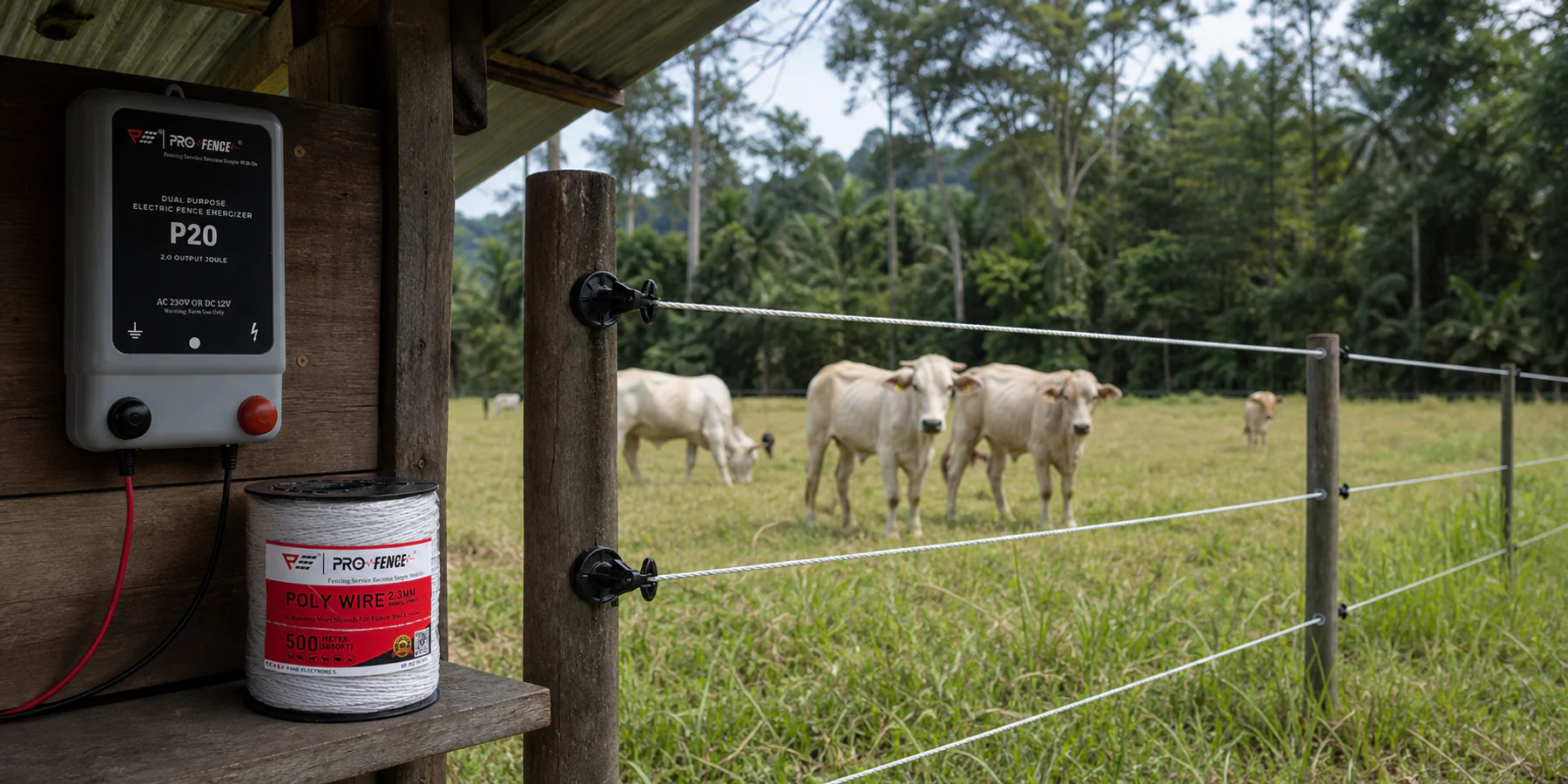
What Is an Electric Fence?
An electric fence is a barrier that deters animals with a brief, high-voltage electric pulse delivered through a bare wire or tape, rather than relying purely on physical strength to keep them in or out. Touching the wire gives the animal a short, sharp shock — uncomfortable but not damaging — which teaches it to stay clear of the fence line after one or two encounters. Across Malaysia, electric fencing is used on farms and plantations to contain livestock and to keep wildlife such as wild boar, elephants, and monkeys away from crops and property.
What Is an Electric Fence, Exactly?
An electric fence works on a simple psychological principle: an animal that gets shocked once will associate the wire, and often the whole fence line, with pain, and will avoid it afterwards. This is different from a conventional fence, which must be strong enough and tall enough to physically stop an animal by force. An electric fence only needs to be strong enough to carry a wire and deliver a pulse — the deterrent is behavioural, not structural.
Because of this, electric fences can be built lighter, faster, and cheaper per metre than an equivalent physical barrier, while often being more effective against determined or powerful animals such as wild boar or cattle, which can push through or under a weak physical fence but will not challenge a fence that hurts them.
An electric fence system has two jobs at once: it must deliver a pulse strong enough to be felt through an animal's coat, hooves, or skin, and it must do so safely, in short pulses, so that the risk of injury to animals, pets, or people is very low compared with mains electricity.
How an Electric Fence Differs From a Physical Barrier Fence
Both fence types can protect a boundary, but they solve the problem in different ways. The table below compares them directly.
| Factor | Electric Fence | Physical Barrier Fence (chain-link, timber, brick) | |---|---|---| | How it stops animals | Psychological deterrent (shock on contact) | Physical strength and height | | Material cost per metre | Generally lower — thin wire/tape, light posts | Generally higher — heavier materials, more labour | | Installation speed | Fast; a few strands and posts can go up in a day for smaller plots | Slower; foundations, heavier posts, more labour-intensive | | Effectiveness against wild boar/elephants | High, if correctly earthed and powered — animals learn to avoid it | Often defeated by digging under, pushing through, or breaking the barrier | | Ongoing running cost | Low — energizer power draw (mains, solar, or battery) | None, but repair after animal damage can be costly | | Maintenance needs | Requires periodic checks: vegetation, voltage, earthing, wire tension | Lower electrical maintenance, but structural repairs after impact damage | | Visibility to animals | Requires the animal to make contact once to learn — some fences add visual tape for early warning | Immediately visible as a physical obstacle | | Typical use case | Livestock containment, crop and orchard perimeter, wildlife deterrence | Security boundaries, property division, areas needing full physical exclusion |
In practice, many Malaysian farms use a hybrid approach — a lighter physical boundary (or existing drainage/embankment) reinforced with electric wire strands, which combines a visible line with a strong behavioural deterrent at a fraction of the cost of a full physical barrier.
The Core Components of an Electric Fence System
Every electric fence, regardless of size, is built from the same basic parts working together as one circuit.
Energizer (fence charger). The energizer is the heart of the system. It takes power from the mains, a battery, or a solar panel and converts it into short, high-voltage pulses, sent out along the fence wire roughly once per second. The size of energizer needed depends on fence length, number of wire strands, and vegetation load — see our How Many Joules Do I Need? guide for sizing guidance, or use the energizer sizing tool for a specific recommendation.
Fence wire, tape, or polywire. This is the conductor that carries the pulse around the perimeter. Options range from galvanised steel wire and high-tensile wire to polywire (woven strands with fine conductive filaments) and polytape (a wider, more visible ribbon). Choice depends on visibility needs, distance, and budget — covered in detail in our fence wire buying guide.
Posts. Posts hold the wire at the correct height and spacing. They can be timber, steel, or fibreglass, and are usually spaced every few metres, with closer spacing on corners or uneven terrain. Line posts need insulators; corner and strainer posts take more load and are usually set more firmly.
Insulators. Insulators clip or thread onto posts and hold the live wire away from the post itself. Without insulators, a wire touching a wet timber or steel post would leak most of its charge into the ground at that point instead of carrying it around the fence line — this is one of the most common causes of poor performance in badly installed systems.
Earth (grounding) system. The earth system — usually one or more galvanised earth stakes driven into moist soil — is what completes the electrical circuit. When an animal touches the live wire, the pulse travels through the animal, into the ground, and back to the energizer through the earth stakes. A poor or undersized earth system is the single biggest reason an otherwise correctly installed fence feels "weak." See how an electric fence works for the full circuit explanation.
Typical Uses of Electric Fencing in Malaysia
Farm and plantation perimeter protection. Oil palm estates, durian orchards, banana plantations, and vegetable farms across Malaysia use electric fencing to establish a perimeter that keeps both livestock and wildlife off cultivated land, often running for hundreds of metres to several kilometres around a smallholding or estate boundary.
Livestock containment. Goat, sheep, and cattle farms use electric fencing to divide grazing paddocks and to keep animals within a defined area without the cost of building solid stock fencing across an entire farm. Rotational grazing setups, in particular, rely on lightweight, movable electric fencing that can be repositioned as animals move between paddocks.
Wildlife deterrence. This is one of the most common reasons Malaysian farmers install electric fencing:
- Wild boar (babi hutan) are one of the most persistent crop pests in Malaysia, rooting up plots of tapioca, sweet potato, oil palm seedlings, and vegetable crops overnight. A properly earthed, low-strand electric fence is one of the most effective and affordable deterrents against boar, since they test barriers with their snouts and receive a direct, memorable shock.
- Elephants are a serious concern for plantations near forest reserve boundaries in states such as Pahang, Johor, and Kelantan. Elephant deterrent fencing uses higher-output energizers and reinforced wire runs, since a standard small-farm energizer will not produce a pulse strong enough to be felt through an elephant's thick hide, particularly on longer runs.
- Monkeys (long-tailed macaques) raid fruit orchards, especially banana and papaya, and can be deterred with electric wire strands positioned to block climbing or ground-level access points, though monkeys are agile enough that fencing is usually paired with other deterrents for full protection.
Do You Need an Electric Fence or a Physical Fence?
For most Malaysian farms and smallholdings, the decision comes down to what you are protecting against and how much of the boundary needs full physical exclusion.
- If you need to contain livestock or deter animals along a long perimeter on a working budget, an electric fence is usually the more practical and cost-effective choice.
- If you need to stop determined intrusion by people, secure high-value stored goods, or meet a specific security requirement, a physical fence (or a combination of both) is usually necessary.
- If wild boar, monkeys, or general crop-raiding wildlife are the main concern, an electric fence is typically the most effective single investment for the cost.
- If elephants are a known risk in your area, plan for a higher-output, purpose-sized system rather than a standard small-farm setup — see our joules sizing guide before buying.
Is Electric Fencing Safe?
Yes, when correctly installed with a compliant energizer. A genuine electric fence energizer delivers its pulse for a tiny fraction of a second, roughly once per second, rather than a continuous current — this pulsed design is what makes the shock startling rather than dangerous. The technical detail of why this matters, including joules, voltage, and duty cycle, is covered in our companion guide, how an electric fence works.
Frequently asked questions
Is an electric fence dangerous to humans?
A properly installed electric fence using a purpose-built energizer delivers a short, sharp pulse that is startling and uncomfortable but not designed to cause lasting harm to a healthy adult. It should still be treated with respect, and warning signage is good practice on any perimeter that people may approach.
Can an electric fence keep out wild boar in Malaysia?
Yes. Wild boar are one of the most common reasons Malaysian farmers install electric fencing, since a correctly earthed low-strand fence gives a memorable shock when the boar's sensitive snout makes contact, and boar typically avoid the line afterwards.
Do electric fences work on elephants?
They can, but only with a higher-output energizer and a well-built wire run designed for the purpose — a standard small-farm energizer will not produce a strong enough pulse to be reliably felt through an elephant's hide, especially over a long perimeter.
What is the difference between an electric fence and barbed wire?
Barbed wire is a physical barrier that relies on discomfort from sharp points to discourage animals pressing against it, while an electric fence uses an electric pulse as the deterrent and does not need to be physically strong enough to stop an animal by force alone. Never combine the two by energizing barbed wire itself — the barbs can trap an animal or person against the live wire, turning a brief shock into a dangerous, prolonged one. See our [electrified barbed wire danger guide](/guides/electrified-barbed-wire-danger-guide) for why, and how to combine them safely.
How many strands of wire do I need?
It depends on the animal being contained or excluded — smaller or ground-dwelling animals like wild boar typically need two to three lower strands, while livestock containment for goats or cattle often uses three to five strands at different heights. See our [fence wire buying guide](/guides/fence-wire-buying-guide) for specifics.
Does an electric fence work without mains power?
Yes. Energizers are available in mains-powered, battery-powered, and solar-powered versions, so a fence can be installed on remote farmland with no grid connection.
Is an electric fence legal in Malaysia?
Electric fencing for agricultural and property boundary use is widely and legally used across Malaysian farms and plantations. As with any installation, use a compliant, purpose-built agricultural energizer rather than an improvised electrical setup, and post warning signage where the public may come into contact with the fence.
Can electric fencing be used for poultry or chicken runs?
Yes, lightweight electric netting or low-strand wire fencing is commonly used to protect poultry runs from ground predators, in addition to livestock containment uses.
How long does an electric fence last?
With routine maintenance, wire and posts can last many years; the energizer is typically the component with a defined service life, and its lifespan depends on build quality, power source, and exposure to Malaysia's climate.
Do I need a professional to install an electric fence?
Smaller, straightforward perimeters are often installed by farmers themselves using basic kits, while longer runs, wildlife deterrent systems, or complex terrain benefit from professional installation advice to get earthing and energizer sizing right the first time.
What happens if an animal touches the fence?
It receives a brief, sharp pulse through the point of contact, which is startling and unpleasant but of very short duration, and it will typically move away and avoid the fence line afterwards.
Can electric fences be used around fish ponds?
Yes, electric fencing is commonly used around fish ponds in Malaysia to deter otters, monitor lizards, and other predators — see our [electric fence for fish pond](/guides/electric-fence-for-fish-pond) guide for specifics.
How much does an electric fence cost roughly?
Cost depends heavily on fence length, number of strands, energizer output, and terrain, so there is no single figure — for a cost estimate based on your own fence layout, use the [cost estimator tool](/tools/cost-estimator).
Does rain affect an electric fence?
Rain itself does not stop a fence working and can even improve earth conductivity, but heavy vegetation growth after rain, waterlogged connections, and lightning risk all need routine attention — see our [maintenance guide](/guides/electric-fence-maintenance-guide).
What is the difference between electric fence tape and wire?
Tape is wider and more visible to livestock and people, making it popular for horse paddocks and areas with foot traffic, while wire is thinner, cheaper per metre, and typically used for longer perimeter runs and wildlife deterrent fencing — see the [fence wire buying guide](/guides/fence-wire-buying-guide) for a full comparison.